
A - B - C - D - E - F - G - H - I - J - K - L - M - N - O - P - Q - R - S - T - U - V - W - X - Y - Z
Z
Zeitgeber
Pronunciation: TSITE-gay-ber
Definition: A Zeitgeber (German for "time-giver") is any external cue that entrains the endogenous biological rhythms of an organism. The primary Zeitgeber for humans is light, which is sensed by specialized photosensitive retinal ganglion cells. These cells transmit signals via the retinohypothalamic tract to the Suprachiasmatic Nucleus (SCN)—the brain's master clock. Other "non-photic" Zeitgebers include food intake, ambient temperature, social interaction, and physical activity. In nootropic research, Zeitgeber management is the foundation of Sleep-Wake Cycle optimization and the prevention of "Social Jetlag."
The Nootropic Research Interface
Nootropic efficacy is deeply tied to the "Phase Response Curve" (PRC) of the subject's Zeitgebers.
- Photic Entrainment: Research into Blue Light (460-480nm) as a Zeitgeber shows that it suppresses Melatonin production. Nootropics that aim to improve morning alertness often work in synergy with light exposure to "reset" the SCN and increase cortisol awakening responses.
- Metabolic Zeitgebers: Food is a powerful Zeitgeber for peripheral clocks (like the liver). Researchers study Time-Restricted Feeding (TRF) in conjunction with nootropics like Berberine to synchronize metabolic and cognitive rhythms, reducing the "brain fog" associated with circadian misalignment.
- Temperature Modulation: The core body temperature drop is a critical internal cue for sleep. Nootropics like Glycine are researched for their role as "Thermal Zeitgebers," as they promote peripheral vasodilation to lower core temperature and signal the brain that it is time for restorative sleep.
- The Melatonin Paradox: While often used as a sleep aid, Melatonin is technically an Endogenous Zeitgeber. It doesn't just induce sleep; it tells the brain where it is in the 24-hour cycle. Low-dose melatonin research focuses on "Phase-Shifting" the brain to recover from travel or shift work.
The Hierarchy of Zeitgebers
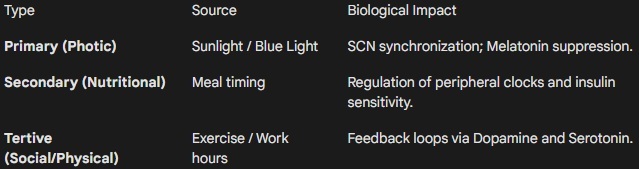
Primary Research Metrics
- DLMO (Dim Light Melatonin Onset): The "gold standard" for determining a subject’s internal clock timing relative to external Zeitgebers.
- Phase Shift: The number of hours the internal clock moves (forward or backward) in response to a Zeitgeber or chronotropic nootropic.
- Actigraphy: The use of wearable sensors to track the "Rest-Activity Cycle," allowing researchers to see how well a subject's lifestyle aligns with their Zeitgebers.
Research Note: Many "failed" nootropic trials for focus and memory may actually be failures of Zeitgeber Alignment. A stimulant administered when the SCN is signaling "sleep phase" will result in lower efficacy and higher side effects compared to the same dose administered during the "circadian peak."
Zuranolone
Pronunciation: zur-AN-oh-lone
Definition: Zuranolone is a synthetic neuroactive steroid that acts as a positive allosteric modulator of the GABA-A receptor. Unlike traditional benzodiazepines, it targets both synaptic and extrasynaptic receptors, providing a more "global" modulation of inhibitory tone. It is a derivative of Allo-pregnanolone.
The Nootropic Research Interface
In the research community, Zuranolone and its precursors are studied for their role in Rapid-Acting Neuroplasticity.
- The Glutamate-GABA Reset: Chronic stress "scrambles" the balance between excitation and inhibition. Zuranolone is researched for its ability to rapidly reset this balance, effectively "clearing the board" for new learning and improved mood.
- HPA-Axis Regulation: By modulating GABA receptors in the hypothalamus, it can dampen the overactive stress response that typically impairs executive function.