
A - B - C - D - E - F - G - H - I - J - K - L - M - N - O - P - Q - R - S - T - U - V - W - X - Y - Z
Y
Yerba Mate
Pronunciation: YUR-buh MAH-tay
Definition: A South American plant (Ilex paraguariensis) researched for its unique stimulant profile. It contains a "synergistic yield" of three alkaloids: Caffeine, Theobromine, and Theophylline.
The Research Edge
Unlike coffee, Yerba Mate is studied for its GLP-1 modulation, which may provide neuroprotective effects and smoother energy delivery without the "caffeine jitter" typical of isolated xanthine administration.
Yield
Pronunciation: YEELD
Definition: In the context of nootropic research, Yield refers to the amount of a specific bioactive compound (the isolate) successfully extracted from a raw source material or produced during a chemical reaction. It is typically expressed as a percentage of the theoretical yield (the maximum possible amount) versus the actual yield. In botanical nootropics, yield is the primary determinant of a product’s potency and standardization (e.g., a "10:1 extract" implies that the yield of concentrated material came from ten times its weight in raw herbs).
The Nootropic Research Interface
Yield is the metric that separates "raw powders" from "research-grade extracts."
- Extract Ratios: Researchers must distinguish between a simple concentration yield (e.g., 5:1) and a standardized yield (e.g., 50% Bacosides). A high weight yield does not always correlate with a high potency yield of the active nootropic molecule.
- Solvent Selectivity: The choice of solvent (water, ethanol, or CO2) determines the "specific yield" of a compound. For instance, an ethanol extract of Lion's Mane will provide a higher yield of alcohol-soluble erinacines (for nerve growth), while a water extract yields more beta-glucans (for immunity).
- Bioavailability vs. Yield: A high yield of a raw compound in a capsule does not guarantee a high yield in the bloodstream. Research into Piperine or Liposomal delivery focuses on increasing the "Biological Yield"—the amount of the compound that survives digestion to reach the target receptors.
YMMV (Your Mileage May Vary)
Pronunciation: yur MILE-ij may VAIR-ee
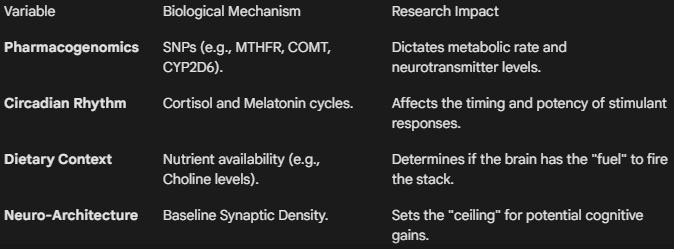
Definition: YMMV is an idiomatic expression used in the nootropic research community to denote inter-subject variability in drug response. It acknowledges that the efficacy, dosage requirements, and side-effect profiles of a specific compound are not universal but are contingent upon a subject's unique genotype, epigenetic expression, neurochemical baseline, and gut microbiome composition. In a clinical context, YMMV represents the "Standard Deviation" in data sets that prevents a "one-size-fits-all" approach to cognitive enhancement.
The Nootropic Research Interface
For the researcher, YMMV is the primary reason why anecdotal "trip reports" must be secondary to controlled, peer-reviewed data. However, it also highlights the necessity of Personalized Nootropics.
- The Genetic Baseline: A primary driver of YMMV is Single Nucleotide Polymorphisms (SNPs). For example, a subject with the COMT Val158Met polymorphism (which causes faster dopamine breakdown) will have a radically different response to a dopaminergic stimulant than someone with the "Slow" variant. To the former, the stimulant is focus-inducing; to the latter, it may cause over-stimulation and anxiety.
- Receptor Density (Bmax): Individual differences in baseline receptor density mean that a "standard" dose of a Racetam might saturate one subject's receptors while being sub-therapeutic for another. This makes "self-titration" a common—though risky—practice in the community.
- Enzymatic Efficiency: Differences in the CYP450 liver enzyme family determine how quickly a nootropic is cleared from the system. A "Fast Metabolizer" will experience a shorter duration of effect, while a "Slow Metabolizer" may experience cumulative toxicity from the same dose.
- The Placebo/Nocebo Overlay: Psychological expectations can create a YMMV effect where the subject's belief in a compound's efficacy alters the actual neurochemical outcome through the prefrontal-mediated release of endogenous opioids or dopamine.
Factors Contributing to YMMV
Primary Research Metrics
- Coefficient of Variation (CV): A statistical measure used to quantify the "spread" of the YMMV effect in a study group.
- Pharmacokinetic/Pharmacodynamic (PK/PD) Modeling: Used to predict how individual variables (like body weight or age) will shift the expected "mileage" of a dose.
- Genomic Sequencing: Increasingly used by advanced "biohackers" to identify specific SNPs that might make certain nootropics ineffective or dangerous for their specific biology.
Research Note: When a researcher encounters a "non-responder" in a trial, it is often a manifestation of YMMV. Rather than dismissing the compound, the researcher must look for the biomarker that differentiates the non-responder from the responder—effectively turning "YMMV" into a data point for precision medicine.