
A - B - C - D - E - F - G - H - I - J - K - L - M - N - O - P - Q - R - S - T - U - V - W - X - Y - Z
U
Upregulation
Pronunciation: UP-reg-yoo-LAY-shun
Definition: Upregulation is the process by which a cell increases the quantity of a specific cellular component, such as RNA or protein (specifically receptors), in response to an external stimulus. In neuropharmacology, this is most frequently observed as an increase in the number or sensitivity of postsynaptic receptors following a period of chronic under-stimulation or the administration of an antagonist. It is the inverse of downregulation and serves as a fundamental mechanism for restoring homeostatic equilibrium in the central nervous system.
The Nootropic Research Interface
For the researcher, upregulation is often the "holy grail" of long-term cognitive enhancement, as it represents a structural improvement in the brain's "hardware" rather than a temporary chemical spike.
- Receptor Density (Bmax): The primary goal of many "recovery" stacks is to upregulate receptors that have been downregulated by stimulant abuse. For example, researchers study Uridine for its ability to upregulate Dopamine (D1/D2) receptor density, potentially reversing tolerance and restoring baseline motivation.
- Enzymatic Upregulation: Nootropics can also upregulate the production of endogenous antioxidants. Compounds like Sulforaphane act on the Nrf2 pathway to upregulate the synthesis of glutathione and superoxide dismutase, effectively upgrading the brain's internal defense systems.
- Trophic Priming: Increasing the expression of receptors for growth factors (like TrkB receptors for BDNF) is a form of upregulation that makes neurons more responsive to "fertilizing" signals, accelerating the rate of learning and repair.
- Antagonist-Induced Upregulation: Chronic blockade of a receptor can trick the brain into thinking there is a deficiency, leading it to "sprout" more receptors to catch every available signal. This is why caffeine (an adenosine antagonist) leads to an upregulation of adenosine receptors, contributing to the "caffeine withdrawal" effect when the blockade is removed.
Upregulation vs. Downregulation
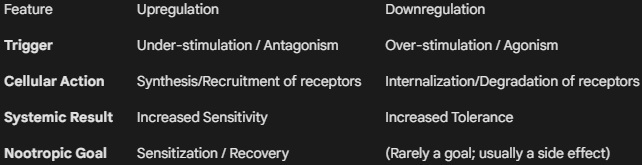
[Image comparing the mechanisms of receptor upregulation and downregulation]
Primary Research Metrics
- Radioligand Binding Assays: A technique used to quantify the change in the total number of available binding sites (Bmax) to confirm that upregulation has occurred.
- mRNA Expression (qPCR): Researchers measure the levels of messenger RNA to see if the cell is "ordered" to produce more receptor proteins at the genetic level.
- Long-Term Sensitization: Behavioral studies in animal models that measure an increased response to a previously "normal" dose of a compound, indicating a more sensitive neural environment.
Research Note: Upregulation is a metabolically expensive and time-consuming process for the neuron. Unlike the rapid "shut-down" of downregulation, upregulating a receptor system can take weeks of consistent signaling or specific nutrient availability (like phospholipids for membrane construction). This explains the "lag time" often seen in the efficacy of neuro-regenerative nootropic protocols.
Uptake
Pronunciation: UP-tayk
Definition: Uptake is the physiological process by which a cell actively or passively internalizes molecules—such as nutrients, precursors, or neurotransmitters—from the surrounding interstitial fluid. This process is mediated by specialized transporter proteins or via endocytosis. In neurobiology, uptake is categorized into two primary research streams: Nutrient Uptake (the acquisition of raw materials like glucose or amino acids) and Neurotransmitter Uptake (the removal of signaling molecules from the synapse to regulate signal duration).
The Nootropic Research Interface
For the researcher, optimizing "Uptake Efficiency" is often the bottleneck between a compound’s systemic presence and its actual cognitive effect.
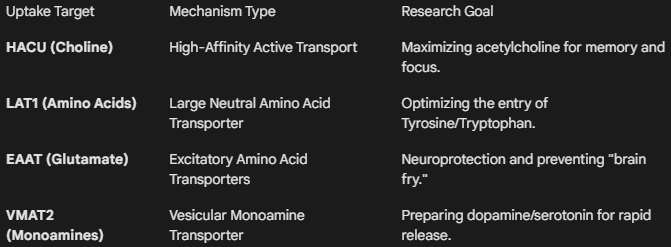
- Rate-Limiting Precursor Uptake: The brain's ability to synthesize neurotransmitters is often limited by how fast it can "pull" precursors across the cell membrane. For example, the High-Affinity Choline Uptake (HACU) system is the rate-limiting step in acetylcholine synthesis; nootropics like Coluracetam are specifically researched for their ability to "supercharge" this uptake mechanism.
- The Competition Effect: Many amino acid precursors (like L-Tyrosine and L-Tryptophan) share the same transport carriers to cross the blood-brain barrier and enter neurons. Researchers study "Competitive Uptake" to ensure that a high dose of one nootropic doesn't accidentally block the uptake of another essential nutrient.
- Glial Uptake: Not all uptake occurs in neurons. Astrocytes (glial cells) perform critical "Glutamate Uptake" to prevent excitotoxicity. Nootropics that enhance glial uptake are highly valued for their neuroprotective properties, as they "clean" the neural environment of excess excitatory "noise."
- Vesicular Uptake: Once inside the neuron, neurotransmitters must undergo Vesicular Uptake—being pumped into storage sacs for future release. This is an ATP-dependent process, making mitochondrial health a prerequisite for efficient neurotransmitter "recycling."
Uptake Profiles in Nootropic Science
Primary Research Metrics
- Vmax (Maximum Velocity): The maximum rate at which a transporter can move a substance into the cell. If a nootropic increases Vmax, it is essentially "widening the pipe" for neural fuel.
- Km (Michaelis Constant): The concentration of a substrate at which the uptake rate is half of Vmax. A lower Km indicates a higher "affinity," meaning the cell can effectively pull in the substance even at low concentrations.
- Radioactive Tracer Labeling: A method used in in vitro studies to track the exact speed and volume of a nootropic's uptake into specific brain tissue samples.
Research Note: It is crucial to distinguish Uptake from Reuptake. While "Uptake" is the general term for internalization, Reuptake refers specifically to the retrieval of a neurotransmitter that the cell just released. In stack design, we often want to increase the uptake of precursors (like Alpha-GPC) while inhibiting the reuptake of active signals (like Dopamine) to prolong their effect.