
A - B - C - D - E - F - G - H - I - J - K - L - M - N - O - P - Q - R - S - T - U - V - W - X - Y - Z
T
Tolerance
Pronunciation: TOL-er-unss
Definition: Tolerance is a physiological state characterized by a diminished response to a nootropic or stimulant following repeated administration. It is a manifestation of neurobiological homeostasis, where the central nervous system (CNS) adjusts its internal environment to offset the "deviation" caused by the substance. This necessitates an increase in dosage to achieve the original qualitative or quantitative effect. In nootropic research, tolerance is categorized into three primary mechanisms: pharmacodynamic (receptor changes), metabolic (accelerated clearance), and behavioral (conditioned compensation).
The Nootropic Research Interface
For the researcher, managing tolerance is the primary challenge in maintaining the long-term viability of a "Performance Stack."
- Receptor Downregulation: The most common form of tolerance. When a receptor is over-stimulated by an agonist (like a dopaminergic stimulant), the cell "internalizes" or deactivates those receptors to prevent excitotoxicity. This reduces the "landing sites" available for the nootropic, leading to the "diminishing returns" effect.
- Enzymatic Induction: Some compounds induce the liver or brain to produce more of the enzymes responsible for their breakdown (e.g., Cytochrome P450). This shortens the half-life of the nootropic, requiring more frequent dosing to maintain stable plasma levels.
- Transporter Upregulation: In response to reuptake inhibitors, the brain may increase the density of transporter proteins (like DAT or SERT) to restore the "recycling" speed of neurotransmitters, effectively neutralizing the nootropic's mechanism of action.
- Glutamate-GABA Balancing: Tolerance to anxiolytic nootropics (like Phenibut) often involves a rapid shift in the ratio of inhibitory to excitatory signaling, where the brain increases glutamate sensitivity to counter the exogenous GABAergic push.
Primary Research Metrics
- ED50 Shift: The "Effective Dose" required to produce a 50% response. A rightward shift in the dose-response curve is a definitive indicator of tolerance.
- Receptor Binding Potential (BP): Measured via PET scans to determine if the physical number of available receptors has decreased.
- Cross-Tolerance Index: A measure used to determine if tolerance to one compound (e.g., Caffeine) results in a diminished response to another in the same class (e.g., Theacrine).
Research Note: It is vital to distinguish between Tolerance and Tachyphylaxis. Tolerance is a gradual process occurring over days or weeks, whereas tachyphylaxis is an acute, rapid onset of drug insensitivity that can occur after only a few doses (often seen with high-dose stimulants or certain serotonergic agents).
Trophic Factors
Pronunciation: TROH-fik FAK-terz
Defintion: Trophic factors (also known as neurotrophins) are a family of endogenous signaling proteins that regulate the survival, development, and function of neurons. They function by binding to specific tyrosine kinase receptors (Trk) to initiate intracellular signaling cascades that prevent apoptosis (programmed cell death) and promote synaptogenesis. In nootropic research, these factors are the primary targets for long-term cognitive "upgrading," as they move beyond temporary neurochemical shifts to achieve permanent structural changes in the brain.
The Nootropic Research Interface
Research into "Trophic-Priming" focuses on how we can induce the brain to produce its own growth factors or mimic their effects.
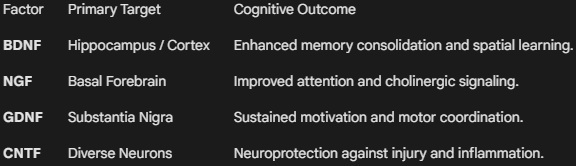
- BDNF (Brain-Derived Neurotrophic Factor): Often called "Miracle-Gro for the brain," BDNF is the most researched trophic factor. It is essential for Long-Term Potentiation (LTP). Nootropics like 7,8-Dihydroxyflavone or lifestyle interventions like high-intensity exercise are studied specifically for their ability to upregulate BDNF levels.
- NGF (Nerve Growth Factor): Primary to the growth and maintenance of cholinergic neurons. Nootropics like Lion’s Mane (Hericium erinaceus) contain compounds (hericenones and erinacines) that are researched for their ability to cross the blood-brain barrier and stimulate endogenous NGF production.
- GDNF (Glial Cell Line-Derived Neurotrophic Factor): Critical for the survival of dopaminergic and motor neurons. Research into GDNF-enhancing agents is a frontier in preventing the cognitive and motor decay associated with aging.
- The "Trk" Receptor Affinity: Because large protein molecules like BDNF cannot easily cross the blood-brain barrier, current research focuses on TrkB agonists—smaller molecules that can "mimic" the trophic factor by plugging directly into the receptor.
Key Neurotrophins in Nootropic Research
Primary Research Metrics
- Serum BDNF Levels: While not a perfect proxy for brain levels, it is the standard clinical measurement used to track the efficacy of "neuro-regenerative" stacks.
- Dendritic Arborization: The complexity of a neuron’s "branching" structure; researchers use staining techniques to see if a trophic agent has increased the number of synaptic connections.
- Trk Phosphorylation: A biochemical marker used to verify that a nootropic has successfully activated the growth receptor pathway.
Research Note: Unlike stimulants, which have an immediate onset, the effects of Trophic Factors are cumulative and delayed. Clinical trials often show that while "Focus" may not improve in hour one, the "Rate of Learning" and "Memory Retention" show significant statistically relevant improvements after 4 to 8 weeks of sustained trophic modulation.