
A - B - C - D - E - F - G - H - I - J - K - L - M - N - O - P - Q - R - S - T - U - V - W - X - Y - Z
S
Serotonin
Pronunciation: ser-uh-TOH-nin
Definition: Serotonin is a monoamine neurotransmitter synthesized from the essential amino acid L-Tryptophan via the intermediate 5-HTP. While widely distributed throughout the body (primarily in the enteric nervous system), central nervous system (CNS) serotonin is produced in the Raphe Nuclei of the brainstem. It exerts its effects through at least 14 distinct receptor subtypes (primarily G-protein coupled, with the exception of the ionotropic 5-HT3). In nootropic research, serotonin is characterized as a master modulator that regulates mood, sleep-wake cycles, satiety, and social hierarchy behavior, often acting to inhibit impulsive or aggressive "noise" in neural circuits.
The Nootropic Research Interface
In stack design, serotonin is often managed to prevent "burnout" or to balance the high-cortisol states associated with intensive stimulant use.
- The Executive Brake: Serotonin provides the "top-down" control necessary for executive function. Low serotonergic tone is researched for its link to impulsivity and "cognitive inflexibility," where a researcher cannot easily switch between tasks.
- Serotonin-Dopamine Antagonism: There is a delicate "seesaw" relationship between these two systems. High dopamine can sometimes suppress serotonin, leading to irritability. Nootropics like L-Theanine are researched for their ability to subtly elevate serotonin levels to "smooth out" the jagged edge of dopaminergic stimulants.
- Neuroplasticity and BDNF: Beyond mood, serotonin signaling is a major trigger for the release of Brain-Derived Neurotrophic Factor (BDNF). This makes serotonergic health a requirement for long-term memory consolidation and structural neuroplasticity.
- The Gut-Brain Axis: Since roughly 90% of the body's serotonin is located in the gut, researchers study probiotics and "psychobiotics" for their ability to influence brain serotonin levels indirectly through the vagus nerve.
Primary Research Metrics
- 5-HIAA Levels: The primary metabolite of serotonin measured in urine or CSF to estimate "Serotonin Turnover"—how fast the brain is using and recycling its supply.
- Platelet Serotonin: Often used as a peripheral proxy for central serotonin levels in clinical studies.
- Tryptophan Depletion (ATD): A research technique where subjects are deprived of tryptophan to temporarily lower serotonin levels, allowing researchers to observe the immediate impact on mood and memory.
Research Note: A critical safety boundary in this field is Serotonin Syndrome. This is a potentially fatal condition caused by an over-accumulation of serotonin, usually from stacking multiple "Serotonergic" agents (e.g., combining an SSRI, 5-HTP, and an MAOI). In your dictionary, this should be highlighted as the absolute contraindication for aggressive serotonergic stacking.
Serotonin Syndrome
Pronunciation: ser-uh-TOH-nin SIN-drohm
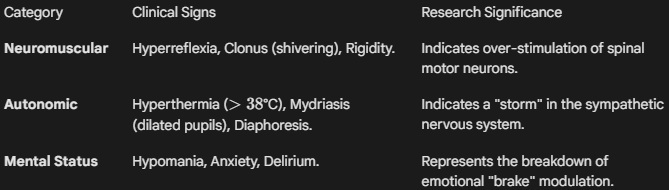
Definition: Serotonin Syndrome is a potentially life-threatening condition resulting from therapeutic drug use, self-poisoning, or unintended pharmacodynamic interactions that lead to excessive synaptic serotonin levels. It is characterized by a triad of clinical features: neuromuscular excitability (e.g., tremors, clonus), autonomic hyperactivity (e.g., tachycardia, hyperthermia), and altered mental status (e.g., agitation, confusion). Pathophysiologically, it is primarily driven by the over-stimulation of central and peripheral 5-HT1A and 5-HT2A receptors.
The Nootropic Research Interface
In the context of cognitive enhancement, Serotonin Syndrome is the primary risk associated with "aggressive" stacking of serotonergic agents.
- Mechanism of Toxicity: SS rarely occurs from a single nootropic at standard doses. It typically emerges when two or more substances that increase serotonin via different mechanisms are combined. For example, stacking a Precursor (like 5-HTP), a Reuptake Inhibitor (like St. John's Wort), and a Releasing Agent can lead to a "serotonergic flood" that exceeds the brain's clearance capacity.
- The MAOI Danger Zone: The most severe cases involve Monoamine Oxidase Inhibitors (MAOIs). Because MAOIs disable the enzyme responsible for breaking down serotonin, combining them with almost any other serotonergic nootropic can trigger a rapid, fatal escalation of 5-HT levels.
- Mild vs. Severe Presentation: Research distinguishes between "Serotonin Toxicity" (mild jitteriness, insomnia, and sweating) and full-blown "Serotonin Syndrome." Many nootropic users may inadvertently experience mild toxicity, which can be a precursor to a medical emergency if dosages are not adjusted.
The Clinical Triad of Symptoms
High-Risk Stacking Combinations
- Precursor + SSRI: Combining 5-HTP or L-Tryptophan with pharmaceutical antidepressants.
- Reuptake Inhibitor + Reuptake Inhibitor: Combining Sceletium tortuosum (Kanna) with other serotonin-acting herbs or drugs.
- Metabolic Inhibitors: Using "potentiators" (like Piperine or Quercetin) that may inadvertently slow the breakdown of serotonergic compounds, leading to cumulative toxicity.
Primary Research Metrics
- Hunter Toxicity Criteria: Currently the most accurate clinical tool for identifying SS, prioritizing clonus (involuntary muscle contractions) as the most predictive sign.
- 5-HT Receptor Antagonism: Researchers study compounds like Cyproheptadine as the "antidote" for SS, as they compete for and block the over-stimulated 5-HT sites.
- Core Temperature Monitoring: In animal models, the rate of hyperthermic increase is used to quantify the severity of the serotonergic reaction.
Research Note: Because many nootropics have "hidden" serotonergic properties (e.g., certain Racetams or adaptogens like Ashwagandha), a washout period is often recommended when switching between potent stacks to ensure the system has reached a baseline before introducing new serotonergic variables.
Short-term Memory
Pronunciation: SHORT-term MEM-uh-ree
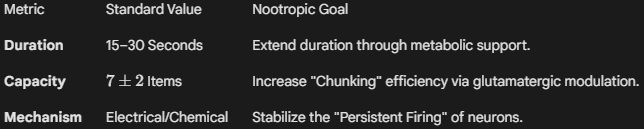
Definition: Short-term memory refers to the phase of memory processing responsible for holding a limited amount of information in an active, readily available state for a brief period (typically 15 to 30 seconds). Unlike long-term memory, which relies on structural protein synthesis and stable synaptic changes, STM is primarily sustained by transient patterns of neuronal firing and localized electrochemical gradients. In nootropic research, STM is distinguished from Working Memory by its role as a passive storage buffer, whereas working memory involves the active manipulation of that stored data.
The Nootropic Research Interface
Research into STM-enhancing nootropics focuses on maintaining the "electrical persistence" of neurons to prevent premature information decay.
- Ionic Gradient Maintenance: STM is highly dependent on the rapid flux of ions (specifically Ca2+ and Na+) across the cell membrane. Nootropics that support Mitochondrial ATP production, such as CoQ10 or PQQ, are researched for their ability to fuel the ion pumps required to keep these "active" memory traces firing.
- The Cholinergic Surge: Acetylcholine is the primary neurotransmitter associated with the "gating" of short-term information. By increasing acetylcholine levels via Acetylcholinesterase Inhibitors (like Huperzine A), researchers can increase the "vividness" and duration of the short-term buffer.
- Trace Decay Prevention: The "Decay Theory" suggests that STM traces simply fade over time if not rehearsed. Nootropics like Bacopa Monnieri are studied for their ability to reduce this decay rate, allowing for a higher percentage of information to successfully transition to the Consolidation phase.
- Calcium Channel Modulation: Because the "release" of memory packets is calcium-dependent, compounds that modulate L-type calcium channels are a major area of study for improving the reliability of short-term retrieval under stress.
The Limitations of the STM Buffer
Primary Research Metrics
- Digit Span Task: A standardized test measuring the maximum number of digits a subject can recall immediately after presentation. This is the gold-standard metric for assessing STM capacity.
- Delayed Match-to-Sample (DMTS): A behavioral task used in animal and human trials to determine how long a subject can retain the "identity" of a stimulus before the memory trace is lost.
- Theta-Gamma Coupling: An EEG metric that measures the coordination between different brain wave frequencies; strong coupling is often a biomarker for high-efficiency short-term storage.
Research Note: While often used interchangeably in casual conversation, a researcher must distinguish between Short-Term Memory (the storage) and Working Memory (the processor). A nootropic that increases the "size" of the storage (STM) may not necessarily improve the "speed" of the processing (Working Memory), though the two systems are highly interdependent.
Stimulant
Pronunciation: STIM-yoo-lunt
Definition: A stimulant is any substance that increases physiological or neurological activity by enhancing catecholaminergic signaling, specifically targeting Dopamine, Norepinephrine, and to a lesser extent, Serotonin. Unlike "pure" nootropics, which may improve cognition through structural or metabolic support without increasing arousal, stimulants operate primarily through the sympathomimetic induction of the "fight-or-flight" response. At the molecular level, this is achieved through diverse mechanisms including reuptake inhibition, direct receptor agonism, or the facilitated release of neurotransmitter vesicles into the synaptic cleft.
The Nootropic Research Interface
In the study of cognitive enhancement, stimulants are categorized as "Acute Performance Enhancers." Research focuses on finding the "Goldilocks Zone" where arousal increases without triggering cognitive fragmentation.
- Vigilance and Arousal: Stimulants act on the Reticular Activating System (RAS) to decrease the perception of fatigue and increase the duration of sustained attention. Researchers use compounds like Modafinil to study wakefulness without the peripheral "jitter" associated with classical amphetamines.
- The Catecholamine Baseline: According to the Inverted-U Hypothesis, individuals with low baseline dopamine (e.g., in ADHD or sleep-deprived states) show significant cognitive gains from stimulants, whereas those at optimal baselines may experience "over-arousal," leading to impaired executive function.
- Glycogen Depletion: Stimulants increase the metabolic "burn rate" of the brain. High-level research examines the requirement for co-administration of Glucose or MCTs to prevent the "stimulant crash," which is often a result of local fuel exhaustion in the prefrontal cortex.
- Secondary Neurotoxicity: A major area of study is the prevention of oxidative stress. Excessive dopamine release can lead to the formation of reactive oxygen species (ROS). Researchers often "stack" stimulants with Antioxidants (like Alpha-Lipoic Acid) to mitigate this risk.
Primary Research Metrics
- VO2 Max (Cerebral): Measurement of the increase in oxygen consumption in the brain following administration.
- Critical Flicker Fusion Threshold (CFFT): A metric used to measure sensory processing speed and CNS arousal levels.
- P300 Evoked Potential: An EEG component related to the brain’s reaction to a specific stimulus; stimulants typically decrease the latency (increase the speed) of the P300 wave.
Research Note: The critical distinction between a Stimulant and a Nootropic (as per Corneliu Giurgea’s original criteria) is the presence of side effects. True nootropics should be "non-stimulatory" and "neuroprotective," whereas stimulants carry the risk of vasoconstriction, tachycardia, and potential addiction due to their direct impact on the brain's reward circuitry (Nucleus Accumbens).
Sublingual
Pronunciation: sub-LING-gwul
Definition: Sublingual administration refers to the placement of a nootropic compound beneath the tongue, where it dissolves and is absorbed directly through the sublingual mucosa. This tissue is highly vascularized, characterized by a thin epithelia and a dense network of capillaries that drain into the deep lingual and facial veins, eventually entering the superior vena cava. By entering the venous circulation directly, the compound bypasses first-pass metabolism in the liver and avoids degradation by gastric acids and intestinal enzymes.
The Nootropic Research Interface
In stack design, the sublingual route is the preferred method for compounds with low oral bioavailability or those requiring a "Quick-Response" (QR) onset.
- Bypassing the Hepatic Filter: Many nootropics, such as Noopept or Melatonin, are heavily metabolized by the liver when swallowed. Sublingual delivery ensures a higher percentage of the "parent compound" reaches the brain, often allowing for significantly lower dosages (e.g., 5mg sublingual vs. 30mg oral) to achieve the same effect.
- Tmax Acceleration: The time to reach peak plasma concentration (Tmax) is radically shortened. This makes the sublingual route ideal for acute cognitive demands, as the effects can often be felt within 3 to 10 minutes, compared to the 45–90 minute window of traditional encapsulation.
- Molecular Size Constraints: Only certain molecules are candidates for sublingual absorption. Generally, compounds must be small (low molecular weight) and possess a specific balance of lipophilicity to penetrate the mucosal membrane.
- Salivary pH Modulation: The rate of absorption is sensitive to the pH of the mouth. Some research-grade sublingual formulations include buffers to ensure the nootropic remains in its non-ionized (neutral) state, which traverses the lipid membrane more efficiently than an ionized (charged) state.
Primary Research Metrics
- Mucosal Permeability Coefficient (Papp): A value used to predict how easily a specific nootropic can pass through the sublingual tissue.
- Area Under the Curve (AUC): Used to quantify the total exposure to the drug; sublingual administration typically shows a higher AUC for the same dose compared to oral.
- Saliva-Plasma Ratio: A measurement used to determine how much of the compound was successfully absorbed versus how much was swallowed with saliva.
Research Note: A common error in sublingual research is the "Washout Effect," where the subject swallows the dissolved compound too early, converting the administration back into an oral route. To maintain the integrity of the sublingual data, the compound should be held until it is completely dissolved, and water should be avoided for several minutes post-absorption.
Synapses
Pronunciation: SIN-ap-sez
Definition: A synapse is a specialized structure that permits a neuron (or nerve cell) to pass an electrical or chemical signal to another neuron or to a target effector cell. While electrical synapses (gap junctions) allow for direct ionic flow, the majority of research in nootropics focuses on chemical synapses. These consist of a presynaptic terminal (containing neurotransmitter vesicles), a postsynaptic density (containing receptors), and the intervening synaptic cleft. The synapse is not a static bridge but a dynamic "computational" node that can strengthen or weaken its signal transmission based on activity levels.
The Nootropic Research Interface In the study of cognitive enhancement, the synapse is the primary theater of operation. Nootropics generally aim to optimize one of three synaptic functions:
- Synaptic Plasticity: This is the brain's ability to change the "weight" of a synapse. Nootropics like Longipep or Cerebrolysin are researched for their ability to promote Long-Term Potentiation (LTP), where the synapse becomes more responsive to signaling, effectively "hardwiring" a memory.
- Synaptic Density: The sheer number of synapses in a given brain region (like the hippocampus) correlates with cognitive reserve. Nootropics classified as synaptogenic (e.g., Uridine + DHA + Choline) provide the raw phospholipid materials required to build and maintain these connections.
- Synaptic Pruning and Maintenance: To prevent "noise" in the neural network, the brain must prune inefficient synapses. Compounds like Lion's Mane are investigated for their role in modulating Nerve Growth Factor (NGF), which ensures that only the most efficient synaptic connections are preserved and nourished.
- Vesicular Trafficking: The efficiency of a synapse depends on how quickly it can "reload" its neurotransmitter packets. Nootropics that target the SNARE complex or mitochondrial energy production improve the speed of this reload, preventing synaptic fatigue during high-intensity cognitive tasks.
Primary Research Metrics
- Synaptophysin Levels: A glycoprotein found in synaptic vesicles; it is used as a quantitative marker to determine if a nootropic is increasing the total number of functional synapses.
- Paired-Pulse Facilitation (PPF): A measure of short-term synaptic plasticity used to determine if a compound increases the probability of neurotransmitter release.
- Excitatory Postsynaptic Potential (EPSP): The "voltage change" recorded at the synapse; an increase in EPSP amplitude is a standard indicator of enhanced synaptic strength.
Research Note: When discussing "Brain Plasticity," researchers are almost exclusively referring to the Synaptic level. While new neurons can grow (neurogenesis), the vast majority of cognitive gains from nootropics come from making existing synapses more efficient, more numerous, or more resilient to oxidative stress.