
A - B - C - D - E - F - G - H - I - J - K - L - M - N - O - P - Q - R - S - T - U - V - W - X - Y - Z
R
Racetams
Pronunciation: RASS-uh-tams
Definition: Racetams are a structural class of compounds sharing a core 2-pyrrolidone nucleus. The group is defined by its diverse modulation of central nervous system (CNS) activity, primarily through the positive allosteric modulation of ionotropic glutamate receptors (AMPA and NMDA) and the enhancement of cholinergic neurotransmission. Unlike classical stimulants, racetams typically do not act as direct receptor agonists or reuptake inhibitors; instead, they function as "metabolic tuners" that improve the efficiency of existing neural pathways without significant affinity for dopamine or norepinephrine receptors.
The Nootropic Research Interface
Racetams are the most extensively studied class of nootropics, serving as the benchmark for measuring cognitive "fluidity" and synaptic plasticity.
- The Glutamate Hypothesis: Research focuses on the ability of racetams to "prime" AMPA receptors, making them more sensitive to glutamate. This facilitates Long-Term Potentiation (LTP), the biological mechanism behind learning and memory formation.
- Acetylcholine Sensitization: Racetams are often termed "cholinergic potentiators." They increase the high-affinity choline uptake (HACU) in the hippocampus. Because they increase the utilization of acetylcholine, research protocols almost always pair a racetam with a high-quality Choline Source (like Alpha-GPC) to prevent "choline headaches" caused by neurotransmitter depletion.
- Membrane Fluidity: At a cellular level, racetams (specifically Piracetam) restore the fluidity of the neuronal lipid bilayer. This ensures that membrane-bound proteins and receptors can move and function with maximum efficiency, particularly in the aging brain.
- Vascular & Oxygen Utilization: Some racetams improve cerebral blood flow (microcirculation) and increase glucose and oxygen consumption in the brain, providing the metabolic "fuel" required for heightened states of focus.
The Racetam Hierarchy in Research
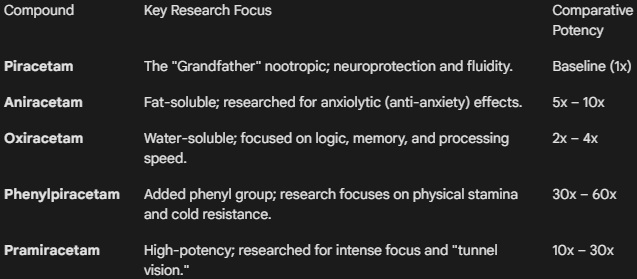
Primary Research Metrics
- AMPA Receptor Occupancy: Measured to determine the degree of allosteric modulation within the hippocampus.
- Cerebral Metabolic Rate of Glucose (CMRglc): Used in PET imaging to visualize the increase in energy expenditure triggered by racetam administration.
- Electrophysiological Recording: Measuring the "slope" of synaptic responses in brain slices to quantify the enhancement of signal transmission.
Research Note: Because racetams work by modulating existing signals, they are "State-Dependent." They tend to show more dramatic results in subjects experiencing cognitive decline, sleep deprivation, or high-stress environments than in rested, "optimized" subjects. This makes them a primary focus for research into "Cognitive Rescue" protocols.
Recall
Pronunciation: REE-kahl
Definition: Recall is the neurobiological process of accessing and retrieving information previously encoded and stored in long-term memory. Unlike Recognition (which requires an external sensory cue to identify information), recall involves the endogenous reconstruction of a memory trace. It is governed by the hippocampal-prefrontal cortex axis, requiring the brain to reactivate the specific neural ensembles that were active during the initial learning event. In nootropic research, recall is the primary metric used to evaluate the efficacy of Long-Term Potentiation (LTP) and synaptic plasticity.
The Nootropic Research Interface
For the researcher, optimizing recall is often more complex than improving encoding. It requires a balance of neurochemistry that allows for "high-speed" data retrieval.
- Cholinergic Efficiency: Recall is heavily dependent on Acetylcholine levels. Nootropics like Huperzine A or Alpha-GPC are studied for their ability to facilitate the "searching" function of the brain by maintaining high synaptic concentrations of acetylcholine during retrieval tasks.
- Glutamatergic Signaling: The strength of the "recall signal" is determined by the sensitivity of AMPA and NMDA receptors. Racetams are often used in research to "potentiate" these receptors, effectively lowering the threshold of energy required to "pull" a memory from storage.
- State-Dependent Recall: Research shows that recall is most effective when the internal chemical state (e.g., caffeine levels, stress hormones) matches the state the researcher was in during encoding. Nootropics that stabilize the internal milieu can help mitigate "blocking" or "tip-of-the-tongue" phenomena.
- Retrieval vs. Storage: A critical distinction in studies: a compound might improve the storage of a memory but fail to improve recall if it induces too much background "noise" or anxiety (hyper-dopaminergic states).
Types of Recall in Clinical Trials
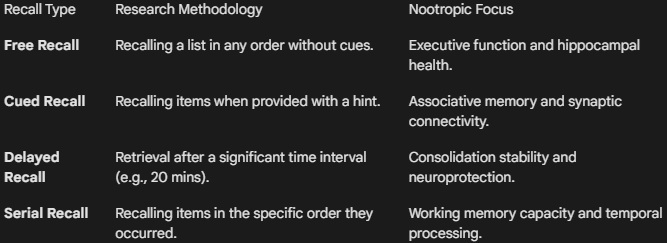
Primary Research Metrics
- Delayed Word List Recall: A standard component of the MMSE or MoCA tests used to quantify cognitive decline or enhancement.
- Retrieval Latency: The time (in milliseconds) it takes a subject to recall a piece of information. Nootropics that improve "processing speed" aim to reduce this latency.
- Forgetting Rate: The mathematical decay of recallable information over time; researchers use this to see if a nootropic "cements" memories more permanently.
Research Note: When testing for recall, researchers must control for interference. Retroactive interference (new info blocking old) and proactive interference (old info blocking new) can both skew results. Nootropics like Bacopa Monnieri are specifically researched for their ability to reduce this interference, thereby clarifying the "retrieval path."
Receptor
Pronunciation: ree-SEP-ter
Definition: A receptor is a specialized protein molecule located on the cell surface (transmembrane) or within the cytoplasm that is shaped to recognize and bind specific signaling molecules, known as ligands (e.g., neurotransmitters, hormones, or nootropics). Upon binding, the receptor undergoes a conformational change, triggering a biochemical cascade or opening an ion channel to alter the neuron's electrical state. In nootropic science, the "Receptor Profile" of a compound determines its specific cognitive effects, duration of action, and potential for tolerance.
The Nootropic Research Interface
Research into cognitive enhancement is essentially a study of Receptor Kinetics—how we can precisely "tune" these proteins to optimize mental output.
- Agonism vs. Antagonism: * An Agonist binds to a receptor and activates it (e.g., Nicotine acting on nicotinic receptors).
- An Antagonist binds to a receptor to block other signals (e.g., Caffeine blocking adenosine receptors to prevent sleepiness).
- Allosteric Modulation: This is the "volume knob" of neurobiology. Some nootropics (like Racetams) don't turn the receptor on or off; they bind to a secondary site to make the receptor more or likey to respond to its natural neurotransmitter.
- Downregulation & Sensitivity: Chronic over-stimulation of a receptor can cause the cell to "hide" or deactivate its receptors to protect itself. This is the biological basis of tolerance. Nootropic research often focuses on "sensitizers" that restore receptor density to improve baseline cognition.
- Binding Affinity (Ki): This metric tells researchers how "sticky" a nootropic is. A compound with high affinity will stay attached to the receptor longer, often resulting in a more potent or longer-lasting effect.
Key Receptor Classes in Nootropics
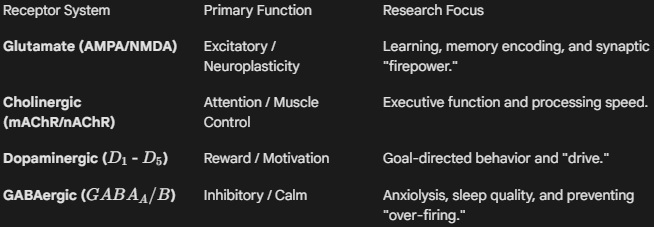
Primary Research Metrics
- Bmax: The maximum density of receptors in a specific brain region; used to see if a nootropic protocol is actually growing "new hardware."
- Occupancy Rate: The percentage of receptors bound by a nootropic at a specific dose; measured via PET imaging to find the "sweet spot" between efficacy and side effects.
- Signal-to-Noise Ratio: How effectively a receptor can distinguish a "real" signal from background chemical "noise" in the brain.
Research Note: A common pitfall in stack design is "Receptor Competition." If two compounds in a stack target the exact same receptor site, they may cancel each other out or cause "receptor burnout." Advanced researchers map out the Receptor Site Map of their entire stack to ensure they are hitting multiple pathways (e.g., one for glutamate, one for acetylcholine) for a synergistic effect.
Reuptake
Pronunciation: ree-UP-tayk
Definition: Reuptake is the process by which neurotransmitters, after being released into the synaptic cleft, are reabsorbed into the pre-synaptic neuron via specialized membrane proteins known as transporters. This process effectively terminates the chemical signal and prevents the over-stimulation of postsynaptic receptors. Once back inside the neuron, the neurotransmitter is either repackaged into vesicles for future use or degraded by enzymes (such as MAO). In nootropic pharmacology, inhibiting this process is a primary method for increasing the "dwell time" and concentration of a target neurotransmitter.
The Nootropic Research Interface
Research into "Reuptake Inhibitors" focuses on how to keep beneficial chemicals in the synapse longer to improve focus, mood, or memory.
- Reuptake Inhibition (RI): By blocking the transporter (the "vacuum cleaner"), a nootropic allows the neurotransmitter to bind to receptors repeatedly. This is the mechanism behind Modafinil (a weak Dopamine Reuptake Inhibitor) and many research chemicals aimed at sustaining executive function.
- Transporter Selectivity: High-fidelity research distinguishes between selective and non-selective inhibitors. For example, a Selective Serotonin Reuptake Inhibitor (SSRI) targets only the SERT transporter, while a Triple Reuptake Inhibitor (TRI) would target Serotonin, Norepinephrine, and Dopamine simultaneously.
- The Recycling Efficiency: Reuptake is an energy-dependent process (ATP). Research into mitochondrial nootropics often examines how increasing cellular energy can improve the speed of reuptake, which is essential for "clearing the slate" so the next signal can be sent clearly.
- Homeostatic Regulation: The brain often responds to reuptake inhibition by downregulating receptors. Researchers study "cycling" protocols to prevent the brain from becoming reliant on blocked reuptake for normal function.
Common Transporter Targets in Research
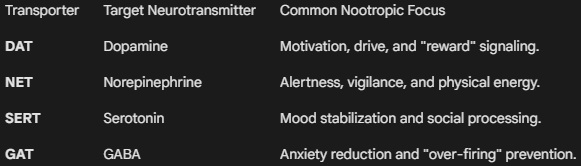
Primary Research Metrics
- IC50 (Inhibitory Concentration): The concentration of a nootropic required to inhibit 50% of a specific transporter's activity. A lower IC50 indicates a more potent reuptake inhibitor.
- Synaptic Half-Life (t1/2): How much longer a neurotransmitter remains active in the cleft when a reuptake inhibitor is present compared to a baseline state.
- Transporter Occupancy: The percentage of transporters physically "plugged" by the nootropic; usually measured via PET scans using radioactive tracers.
Research Note: A common point of confusion is the difference between a Releasing Agent and a Reuptake Inhibitor. A releasing agent (like Amphetamine) pushes more neurotransmitter out into the synapse, whereas a Reuptake Inhibitor (like Methylphenidate) simply prevents it from leaving. In stack design, combining the two can lead to dangerously high levels of neurotransmission, often referred to as a "synergistic overload."