
A - B - C - D - E - F - G - H - I - J - K - L - M - N - O - P - Q - R - S - T - U - V - W - X - Y - Z
Q
Quercetin
Pronunciation: KWER-seh-tin
Definition: Quercetin is a polyphenolic flavonoid found in high concentrations in Allium cepa (onions), Vaccinium species (berries), and Sophora japonica. Chemically, it is a pentahydroxyflavone that acts as a potent antioxidant and anti-inflammatory agent. In neurobiology, it is researched for its ability to traverse the blood-brain barrier (BBB) and modulate intracellular signaling pathways, specifically inhibiting NF-κB and activating SIRT1. It is increasingly categorized as a senolytic, a substance capable of inducing apoptosis in senescent ("zombie") cells within the central nervous system.
The Nootropic Research Interface
In advanced stack design, Quercetin is utilized as a "structural maintenance" nootropic rather than an acute stimulant.
- The Senolytic Protocol: Research often pairs Quercetin with the chemotherapy agent Dasatinib (the D+Q protocol). This combination is studied for its ability to clear age-related senescent cells in the brain, which otherwise secrete pro-inflammatory cytokines that degrade cognitive function.
- Mitochondrial Biogenesis: Quercetin is investigated for its role in upregulating PGC-1α, the master regulator of mitochondrial biogenesis. By increasing mitochondrial density in neurons, it may elevate the "energetic ceiling" required for sustained executive function.
- Zinc Ionophore Properties: In neuro-immunology, Quercetin acts as an ionophore, facilitating the transport of Zinc ions across the lipid bilayer. Intracellular zinc is a critical cofactor for numerous enzymes involved in DNA repair and neurotransmitter synthesis.
- Neuroprotection via Iron Chelation: Quercetin has the capacity to chelate excess transition metals, such as iron, in the brain. By sequestering free iron, it prevents the Fenton Reaction, thereby reducing oxidative stress and lipid peroxidation in neuronal membranes.
Pharmacokinetic Challenges

Primary Research Metrics
- Total Antioxidant Capacity (TAC): A measure used in trials to determine how effectively Quercetin is neutralizing systemic oxidative stress.
- IL-6 and TNF-α Levels: Key inflammatory biomarkers monitored to verify Quercetin's success in dampening "inflammaging" within the brain.
- SIRT1 Activation: Measured to assess Quercetin’s impact on cellular longevity and metabolic efficiency.
Research Note: When sourcing Quercetin for research, the dihydrate form is often preferred for its stability, while anhydrous Quercetin is used when high concentration in a small volume is required. Furthermore, its efficacy is highly synergistic; for example, it has been shown to potentiate the neuroprotective effects of Resveratrol by inhibiting its glucuronidation in the liver.
Quantum Release
Pronunciation: KWAHN-tum ree-LEES
Definition:
Quantum release refers to the process by which neurotransmitters are secreted into the synaptic cleft in discrete, fixed amounts—or quanta—each corresponding to the contents of a single synaptic vesicle. In this model, the total postsynaptic response is the sum of these individual quanta (q). For nootropic researchers, quantum release is a measure of synaptic strength and efficiency, governed by the probability of vesicle fusion (Pr) and the number of available release sites (n).
The Nootropic Research Interface
Nootropics that enhance memory and speed of thought often act by modulating the parameters of quantum release.
- Quantal Content (m): This represents the number of quanta released in response to a single action potential. Racetams (like Piracetam) are researched for their ability to increase quantal content by modulating calcium influx, essentially making each "thought" signal louder and clearer.
- Vesicle Priming: High-performance nootropics often target the SNARE complex, the biological machinery that "primes" vesicles for release. By increasing the pool of readily-releasable vesicles, a compound can reduce "synaptic fatigue" during intense periods of study or work.
- Quantal Size (q): This refers to the actual concentration of neurotransmitters within each individual packet. Nootropic precursors, such as Alpha-GPC or L-Tyrosine, are used to ensure that each "quantum" is fully saturated with the target neurotransmitter, preventing "weak" signaling.
- The "All-or-Nothing" Precision: Because release is quantal rather than continuous, the brain maintains a high signal-to-noise ratio. Research into neurodegenerative inhibitors focuses on preventing the "leakage" of these quanta, which can cause background noise and cognitive fog.
The Quantal Analysis Equation
Researchers use this formula to determine how a nootropic is changing the brain:
- M: Total Mean Response (the "strength" of the focus).
- n: Number of release sites (the "infrastructure").
- Pr: Probability of release (the "readiness").
- q: Quantal size (the "payload").
Primary Research Metrics
- Miniature Excitatory Postsynaptic Currents (mEPSCs): Also known as "minis," these are the electrical signatures of a single quantum being released. Measuring changes in mEPSC frequency vs. amplitude tells a researcher if a nootropic is working on the pre-synaptic (sending) or post-synaptic (receiving) side.
- Vesicular Monoamine Transporter 2 (VMAT2) Activity: A protein that "packs" the quanta. Nootropics that upregulate VMAT2 ensure that each quantum is packed to its maximum capacity.
- Paired-Pulse Facilitation (PPF): A technique used to see if a nootropic increases the probability of release for the second of two rapid signals, a key marker of short-term plasticity.
Research Note: When a nootropic is described as "increasing synaptic efficacy," it almost always means it has altered one of the variables of Quantum Release. Understanding whether a stack increases the number of packets (n) or the size of the payload (q) is essential for predicting its long-term effects on receptor downregulation.
Quaternary Ammonium
Pronunciation: kwah-TER-nuh-ree uh-MOH-nee-um
Definition:
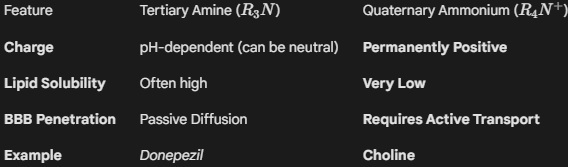
Quaternary ammonium compounds (QACs) are positively charged polyatomic ions of the structure [NR4+], where R represents an alkyl or aryl group. Unlike primary, secondary, or tertiary amines, the nitrogen atom in a quaternary ammonium group carries a permanent positive charge regardless of the surrounding pH. This permanent ionization makes the molecule highly polar and hydrophilic (water-loving), which creates a significant physiological barrier: these compounds cannot passively diffuse through the lipid-rich blood-brain barrier (BBB).
The Nootropic Research Interface
In neuropharmacology, the "Quaternary Challenge" is a central theme when studying cholinergic boosters.
- The Barrier Problem: Essential nootropic precursors like Choline are quaternary ammonium cations. Because they are permanently charged, they cannot "slip" into the brain on their own. They require specialized transporter proteins (such as Choline Transporter 1) to be actively carried across the BBB.
- Peripheral vs. Central Effects: Many quaternary ammonium drugs are designed specifically not to enter the brain. For example, certain muscle relaxants use this structure to ensure they only affect the body (peripheral) without causing sedation or cognitive changes (central).
- Lipid-Bound Solutions: To bypass the limitations of the quaternary structure, researchers developed "disguised" versions like Alpha-GPC and CDP-Choline. By binding the quaternary ammonium group to a lipid (phospholipid), the molecule becomes more "stealthy," allowing for more efficient brain uptake compared to basic choline salts.
Comparison: Tertiary vs. Quaternary Amines
Primary Research Metrics
- LogP Value: A measure of lipophilicity. Quaternary ammonium compounds typically have very low (negative) LogP values, indicating they prefer water over fats.
- Transport Kinetics (Km and Vmax): Because these compounds rely on carriers, researchers measure how quickly the transporters can move the "quaternary payload" into the brain before they become saturated.
- Bioavailability Index: Used to compare how much of a quaternary compound reaches the systemic circulation versus how much is excreted or blocked by the gut-blood barrier.
Research Note: When evaluating a new "Cholinergic" compound, the first question a researcher asks is: "Is it a quaternary amine?" If the answer is yes, the next question must be: "What is the delivery mechanism?" Without a lipid carrier or a specific transporter, a quaternary nootropic will likely have high peripheral activity (like sweating or digestion changes) but very little cognitive impact.
Quick-Response (QR) Stacking
Pronunciation: KWIK ree-SPONS STAK-ing
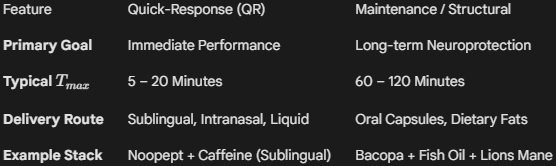
Definition: Quick-Response (QR) Stacking is a formulation methodology characterized by the selection of nootropic compounds and delivery systems that prioritize rapid systemic absorption and immediate Blood-Brain Barrier (BBB) penetration. Unlike "Maintenance Stacking," which focuses on long-term neurogenesis or structural repair, QR Stacks utilize high-solubility molecules and non-enteric administration routes (e.g., sublingual, intranasal, or liquid-fasting states) to achieve peak plasma concentration (Tmax) in significantly reduced timeframes, typically under 15 to 30 minutes.
The Nootropic Research Interface
In clinical and self-directed research, QR Stacks are utilized for "acute cognitive rescue" or to synchronize with specific high-demand tasks.
- Non-Digestive Absorption: The hallmark of a QR stack is the avoidance of the "first-pass metabolism" in the liver. By using sublingual delivery (under the tongue) or buccal delivery (against the cheek), the molecules enter the bloodstream directly via the mucous membranes.
- Solubility Synchronization: QR stacks often utilize Anhydrous forms of compounds (like Caffeine Anhydrous) or high-purity synthetic dipeptides (like Noopept), which are absorbed faster than their bulkier, organic counterparts.
- The Caffeine-Theanine QR Archetype: This is the most studied QR stack. By combining a stimulant with a fast-acting amino acid modulator, the researcher achieves an immediate shift in Alpha-wave brain activity without waiting for the 45-60 minute gastric processing time of a standard capsule.
- pH and Ionization: In QR stacking, the pH of the delivery solution is vital. Researchers may "buffer" a solution to ensure the nootropic remains in its non-ionized state, allowing it to flash across membranes at maximum speed.
QR Stacking vs. Maintenance Stacking
Primary Research Metrics
- Onset of Action (Tonset): The time elapsed between administration and the first measurable change in cognitive biomarkers (e.g., EEG shift).
- Bioavailability Spike: A measure of the "steepness" of the absorption curve. QR stacks aim for a sharp, vertical spike rather than a gradual bell curve.
- Subjective Latency: In human trials, the time reported by the subject before they "feel" the effects, used to correlate with blood-plasma data.
Research Note: While QR Stacking offers immediate utility, it often carries a shorter half-life. Because the body absorbs the "quantum" of the stack all at once, it often metabolizes it just as quickly. Advanced researchers often use a "Hybrid Stack," where a QR layer provides immediate focus while a delayed-release capsule provides a "tail" of energy to prevent a crash.