
A - B - C - D - E - F - G - H - I - J - K - L - M - N - O - P - Q - R - S - T - U - V - W - X - Y - Z
P
Peptide
Pronunciation: PEP-tyde
Definition: A peptide is a short chain of amino acid monomers (typically between 2 and 50) linked by covalent peptide bonds. Unlike larger proteins, peptides are characterized by their lower molecular weight and relative structural simplicity. In the central nervous system, Neuropeptides function as potent modulators of neuronal activity, often co-released with traditional neurotransmitters to fine-tune synaptic response. Because they can act as hormones, growth factors, or neurotransmitters, peptides are the primary "software commands" that regulate complex biological processes like neurogenesis, metabolic rate, and the stress response.
The Nootropic Research Interface
In the field of advanced cognitive enhancement, peptides are considered "Tier 2" or "Professional" nootropics due to their high potency and specific delivery requirements. Research focuses on several key classes:
- Neurotrophic Peptides: These mimic the action of larger growth factors (like BDNF or NGF). For example, Cerebrolysin (a peptide mixture) and Semax are researched for their ability to promote neuronal survival and dendritic branching by bypassing the blood-brain barrier via intranasal or parenteral administration.
- Metabolic & Longevity Peptides: Compounds like MOTS-c or BPC-157 are studied for their "pleiotropic" effects—repairing damaged neural tissue and optimizing mitochondrial function to support the high energy demands of cognition.
- Anxiolytic & Regulatory Peptides: Peptides like Selank act on the GABAergic system to provide anxiolytic effects without the sedative or addictive properties associated with traditional benzodiazepines.
- Bioavailability Challenges: A central theme in peptide research is the "half-life" problem. Most peptides are rapidly degraded by peptidases (enzymes) in the digestive tract. Consequently, research heavily emphasizes Intranasal Delivery (to access the brain via the olfactory bulb) or Subcutaneous Injection to maintain systemic stability.
Structural Hierarchy in Research
- Dipeptides / Tripeptides: Two or three amino acids (e.g., Noopept, which is a proline-containing dipeptide). These are often small enough to be orally active.
- Oligopeptides: Chains of 2 to 20 amino acids.
- Polypeptides: Chains longer than 20 amino acids, but smaller than full-scale proteins.
Primary Research Metrics
- Peptidase Resistance: A measure of how long a peptide survives in the blood or brain before being broken down; often improved through "acetylation" or "amination" of the peptide ends.
- Binding Affinity (K): The equilibrium dissociation constant; used to measure how "tightly" a peptide binds to its target receptor (e.g., the Melanocortin or TrkB receptors).
- C-Terminal/N-Terminal Modification: Standard research notation for describing how the "ends" of a peptide have been chemically altered to increase its half-life or potency.
Research Note: When evaluating "nootropic peptides," researchers must distinguish between endogenous peptides (those made by the body) and synthetic analogs. Analogs are often designed to be "super-agonists," meaning they are many times more potent and long-lasting than the natural versions, which requires significantly more precise dosing (often in the microgram range).
pH
Pronunciation: pee-AYCH
Definition: pH is a logarithmic scale used to specify the acidity or basicity of an aqueous solution. Mathematically, it is defined as the negative base-10 logarithm of the molar concentration of hydrogen ions (H+) in a solution:

In a biological context, the maintenance of physiological pH (typically 7.35 to 7.45 for arterial blood) is essential for protein folding, ion channel gating, and the structural integrity of the blood-brain barrier. In nootropic science, pH is a primary determinant of a compound’s ionization state, which directly influences its ability to permeate cellular membranes.
The Nootropic Research Interface
In the study of cognitive enhancers, pH is the "gatekeeper" of pharmacokinetics and neuroprotection.
- Lipophilicity and Absorption: Most nootropics are weak acids or weak bases. According to the pH Partition Hypothesis, only the non-ionized (uncharged) form of a drug can easily diffuse across the lipid bilayer of the blood-brain barrier. If the local pH causes a nootropic to become ionized, its "bioavailability" to the brain is significantly reduced.
- Excitotoxicity and Acidosis: During periods of intense neural firing or ischemia, local brain pH can drop (acidosis). This shift can alter the function of NMDA Receptors, making them more or less sensitive to glutamate. Research into "pH-sensitive" nootropics focuses on compounds that only become active during these acidic shifts to provide "on-demand" neuroprotection.
- Solubility and Stability: Many nootropics in "stack" form are sensitive to the pH of the delivery medium. For example, certain peptides are rapidly degraded in the high-acid environment of the stomach (low pH), necessitating enteric coating or sublingual delivery to bypass the gastric "acid trap."
- The Creatine-Creatinine Conversion: A classic example in research is Creatine. At a low (acidic) pH, creatine is rapidly converted into the waste product creatinine. Research on "buffered" versions of nootropics aims to stabilize the pH to ensure the active molecule reaches the target tissue intact.
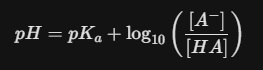
The Henderson-Hasselbalch Relationship
Researchers use this equation to predict how much of a nootropic will be absorbed at a specific pH based on the compound's pKa (the pH at which it is 50% ionized):
Primary Research Metrics
- pKa Value: The acid dissociation constant; used to predict a nootropic's behavior in different parts of the body (e.g., the stomach vs. the bloodstream).
- Buffer Capacity: A measure of a solution's resistance to pH change; vital for maintaining the stability of liquid nootropic formulations.
- Intracellular pH (pHi): Measured using fluorescent dyes to determine if a nootropic is affecting the metabolic state of a neuron in real-time.
Research Note: "Alkaline Diets" are a frequent point of confusion in colloquial nootropic circles. While the pH of a solution matters for drug absorption, the body's systemic pH is tightly regulated by the lungs and kidneys. Nootropic research focuses on local pH (at the site of the synapse or the stomach) rather than attempting to change the overall pH of the blood, which would be clinically dangerous.
Phospholipids
Pronunciation: fos-foh-LIP-ids
Definition: Phospholipids are a class of lipids characterized by a glycerol backbone esterified to two hydrophobic fatty acid "tails" and one hydrophilic phosphate-containing "head" group. In the aqueous environment of the brain, these molecules spontaneously organize into a lipid bilayer, forming the semi-permeable matrix of all neuronal and mitochondrial membranes. In a nootropic context, phospholipids are functional precursors that modulate membrane fluidity, facilitate the docking of neurotransmitter receptors, and serve as reservoirs for secondary messengers and essential neurotransmitters like Acetylcholine.
The Nootropic Research Interface
In neuropharmacology, phospholipids are researched as "Membrane Remodelers." As the brain ages, the ratio of specific phospholipids shifts, leading to "stiff" membranes that hinder signal transduction. Nootropic intervention aims to restore this Homeostatic Fluidity.
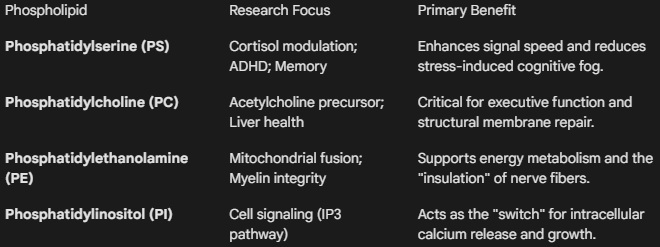
- The Signaling Reservoir: Phospholipids like Phosphatidylcholine (PC) are enzymatic targets. When the brain requires more acetylcholine for focus, it can "cannibalize" PC from the cell membrane to synthesize it. Research into Choline Alfoscerate (GPC) focuses on its ability to provide this raw material without depleting the membrane itself.
- Receptor Kinetics: The efficiency of a receptor (like the 5-HT (Serotonin) or Dopamine receptors) is dependent on the phospholipid environment. If the membrane is too rigid, the receptor cannot change shape effectively to "catch" the neurotransmitter. Phospholipids—specifically Phosphatidylserine (PS)—are researched for their ability to keep these "gates" flexible.
- Bioavailability "Chaperones": Many high-potency nootropics (like Curcumin) have poor absorption. Researchers use Phospholipid Complexes (Phytosomes) to encapsulate these molecules, essentially "disguising" them as fats to slip them through the gut lining and the blood-brain barrier.
- Mitochondrial Support: The inner membrane of the mitochondria is rich in Cardiolipin, a unique phospholipid. Research suggests that optimizing phospholipid intake can improve ATP production by stabilizing the electron transport chain.
The "Big Four" in Nootropic Research
Primary Research Metrics
- Membrane Fluidity (Anisotropy): Measured using fluorescent probes to determine how "liquid" or "solid" a neuronal membrane has become after a nootropic protocol.
- Phospholipid Turnover Rate: The speed at which the brain replaces "old" oxidized phospholipids with new ones; a key marker of neuroregenerative capacity.
- Lipidomics: The large-scale study of cellular lipid pathways; used in clinical trials to see how a "stack" changes the entire lipid profile of the brain.
Research Note: A critical distinction in the literature is the source of the phospholipid. Bovine-sourced PS (once common) has different fatty acid profiles than Soy or Sunflower-sourced PS. Modern research prefers plant-based PS or Krill-sourced phospholipids, as the latter are naturally bound to Omega-3s (DHA/EPA), creating a superior "synergistic" delivery system for the brain.
Potentiation
Pronunciation: poh-ten-she-AY-shun
Definition: Potentiation is a form of positive drug-drug interaction in which the administration of one substance (the potentiator) enhances the physiological or pharmacological response of another substance, despite the potentiator often having little to no observable effect on the target pathway when used in isolation. Mathematically, this is expressed as 1 + 0 > 1. In neurobiology, it often refers to Long-Term Potentiation (LTP)—the persistent strengthening of synapses based on recent patterns of activity, which is the cellular cornerstone of memory formation.
The Nootropic Research Interface
For the "stack" researcher, potentiation is the primary method for increasing efficacy while minimizing the "total chemical load."
- Bioavailability Potentiation: Some compounds exist solely to keep other nootropics from being destroyed by the body. Piperine (from black pepper) is a classic example; it potentiates Curcumin by inhibiting the metabolic enzymes in the liver that would otherwise break it down, increasing its absorption by up to 2,000%.
- Receptor Sensitization: Certain nootropics potentiate others by "priming" the receptor site. For instance, Magnesium (specifically L-Threonate) acts as a gatekeeper for the NMDA receptor. By ensuring the receptor is in an optimal state, it potentiates the effect of other glutamate-modulating nootropics like Piracetam.
- Enzymatic Inhibition: By slowing the "off-switch," a potentiator allows a neurotransmitter to stay active longer. An Acetylcholinesterase Inhibitor (like Huperzine A) potentiates a Choline Source (like Alpha-GPC) by ensuring the resulting acetylcholine isn't immediately degraded.
- LTP (Long-Term Potentiation): Research into "LTP-Enhancers" focuses on compounds that lower the threshold required for a neuron to fire, making it easier for the brain to encode a new memory through repeated stimulation.
Potentiation vs. Additive Effects
Researchers distinguish between these two to avoid "over-stacking":
- Additive (1 + 1 = 2): Taking two stimulants that both increase dopamine. This often leads to increased side effects.
- Potentiation (1 + 0.5 = 3): Taking a stimulant (like Caffeine) with a modulator (like L-Theanine) that refines and extends the focus without adding to the "jitter" or heart rate.
Primary Research Metrics
- EC50 Shift: A measure of how much less of a drug is required to reach a 50% maximal effect when a potentiator is added. A "leftward shift" in the dose-response curve indicates successful potentiation.
- Area Under the Curve (AUC): In pharmacokinetics, potentiation often results in a significantly larger AUC, representing a higher total exposure to the active compound over time.
- Field Excitatory Postsynaptic Potential (fEPSP): A specific electrophysiological measure used in in vitro brain slice studies to quantify the degree of Long-Term Potentiation at the synapse.
Research Note: While potentiation is a powerful tool for enhancing nootropic performance, it carries a "Multiplier Risk." If a researcher potentiates a substance without lowering the base dose, they may inadvertently reach toxic levels or cause receptor downregulation (tolerance) much faster than expected.
Precursor
Pronunciation: pree-KUR-ser
Definition: A precursor is an endogenous or exogenous compound that precedes another in a metabolic pathway and is converted into a more active molecule through enzymatic reaction. In nootropic pharmacology, precursors are primarily used for "Substrate Loading"—providing the brain with an abundance of the specific amino acids or nutrients required to synthesize neurotransmitters like Dopamine, Serotonin, and Acetylcholine. Unlike "direct agonists" that force a receptor to fire, precursors rely on the brain's own rate-limited enzymatic machinery to convert them into active signals "on demand."
The Nootropic Research Interface
In clinical research, precursors are the foundational layer of any sophisticated stack. They are used to prevent "Neurotransmitter Depletion" during periods of high cognitive load or pharmacological stimulation.
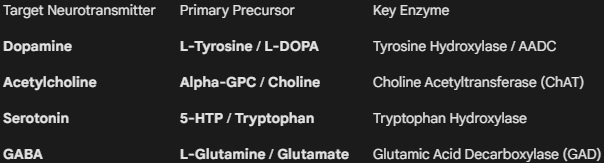
- Rate-Limiting Steps: The conversion of a precursor is usually controlled by a rate-limiting enzyme. For example, the conversion of L-Tyrosine to L-DOPA is governed by Tyrosine Hydroxylase. Researchers use precursors because they are generally safer than direct stimulants; the body will typically stop converting them once optimal levels are reached, reducing the risk of toxicity.
- The Blood-Brain Barrier (BBB) Gateway: Not all precursors can reach the brain. For instance, Serotonin cannot cross the BBB, but its precursor 5-HTP can. Nootropic research focuses on identifying which precursors have the highest BBB permeability to ensure they reach the target neural tissue.
- Precursor Competition: Many amino acid precursors (like Tyrosine and Tryptophan) use the same transport carrier (LAT1) to enter the brain. Research suggests that taking these together can lead to competition, where one "crowds out" the other. Effective stack design requires timing these precursors to maximize individual uptake.
Common Precursor Pathways in Research
Primary Research Metrics
- Synthesis Rate: The speed at which the brain converts the precursor into the active neurotransmitter; often measured via radioactive labeling in PET scans.
- Conversion Efficiency: A ratio comparing the amount of precursor ingested versus the measurable increase in neurotransmitter metabolites (e.g., measuring HVA for dopamine or 5-HIAA for serotonin).
- Plasma-to-Brain Ratio: The concentration of the precursor in the blood compared to its concentration in the cerebrospinal fluid, indicating how effectively it crosses the BBB.
Research Note: "Prodrugs" are often confused with precursors. While both are converted into active substances, a prodrug (like Vyvanse) is a synthetic molecule designed to release a drug, whereas a Precursor is a natural building block used by the body's existing biological assembly lines.
Psychosis
Pronunciation: sy-KOH-sis
Definition: Psychosis is a clinical state characterized by a loss of contact with reality, manifesting as a failure in the brain’s ability to distinguish internally generated stimuli from external sensory input. It is defined by the presence of positive symptoms—specifically hallucinations (sensory perceptions without external stimuli) and delusions (fixed, false beliefs resistant to contradictory evidence)—as well as formal thought disorder (disorganized speech or illogical "loosening of associations"). Neurobiologically, the most widely accepted model is the Dopamine Hypothesis, which posits that psychosis arises from hyperdopaminergic activity in the mesolimbic pathway, leading to the "aberrant salience" of ordinary stimuli.
The Nootropic Research Interface
In the study of cognitive enhancers, psychosis represents the "toxicological ceiling" for many dopaminergic and glutamatergic substances.
- Substance-Induced Psychosis (SIP): Research focuses on how certain "potent" nootropics or research chemicals can trigger transient psychotic episodes. This is particularly relevant for Stimulant-Class Nootropics (e.g., high-dose Modafinil or Amphetamines) which can over-stimulate D2 receptors, and NMDA Antagonists (e.g., Ketamine or PCP derivatives), which induce "dissociative" psychosis by disrupting glutamatergic signaling.
- The "U-Shaped" Response Curve: Many nootropics that improve focus at low doses (by increasing dopamine or glutamate) can trigger psychotic symptoms at higher doses. Researchers use the "Psychotogenic Threshold" to determine the safe upper limit of a compound.
- Cannabis-Induced Psychosis: A major area of study for "herbal nootropics." Research into THC vs. CBD ratios examines how certain phytocannabinoids can either precipitate psychosis or, in the case of CBD, act as an antipsychotic modulator by interfering with D2 signaling.
- Sleep Architecture and Psychosis: Because many nootropic users utilize stimulants to bypass sleep, researchers study the synergistic effect of Sleep Deprivation and cognitive enhancers, as chronic wakefulness alone can degrade reality testing and lead to "micro-psychotic" breaks.
Symptom Classification in Research

Primary Research Metrics
- PANSS (Positive and Negative Syndrome Scale): The gold-standard 30-item medical scale used in clinical trials to quantify the severity of psychotic symptoms before and after a pharmacological intervention.
- Dopamine D2 Receptor Occupancy: Measured via PET scans to determine how much of a substance is binding to D2 sites; occupancy above 80% is often associated with the onset of "extrapyramidal" side effects or psychotic-like states.
- Prodromal Phase Monitoring: In "gero-nootropic" research, scientists monitor the "Ultra-High Risk" (UHR) or prodromal state—subtle changes in behavior that precede a first psychotic episode.
Research Note: A critical distinction in the literature is that Psychosis is a symptom, whereas Schizophrenia is a diagnosis. A researcher can experience drug-induced psychosis without having a psychotic disorder, but the appearance of these symptoms is often viewed as a "contraindication" for further use of that specific nootropic stack.