
A - B - C - D - E - F - G - H - I - J - K - L - M - N - O - P - Q - R - S - T - U - V - W - X - Y - Z
M
Mild-Cognitive Impairment (MCI)
Pronunciation: my-uld KOG-nih-tiv im-PAIR-ment
Definition: Mild Cognitive Impairment is a clinical syndrome characterized by a measurable decline in one or more cognitive domains (e.g., memory, executive function, language, or visuospatial skills) that is greater than expected for an individual’s age and education level, but not severe enough to significantly interfere with daily independent functioning. In a research context, MCI is considered a prodromal state of neurodegeneration, specifically a precursor to Alzheimer’s Disease (AD) or Vascular Dementia.
The Nootropic Research Interface
MCI is the "proving ground" for neuroprotective and regenerative nootropics. Research in this population focuses on slowing the "conversion rate" to dementia:
- The Cholinergic Hypothesis: MCI is often associated with a decline in acetylcholine levels. Nootropics such as Acetylcholinesterase inhibitors (e.g., Huperzine A) or high-potency choline donors (e.g., Alpha-GPC) are researched for their ability to maintain synaptic "tonicity" and delay cognitive erosion.
- Cerebral Hypometabolism: PET scans of MCI patients frequently show reduced glucose uptake in the hippocampus and posterior cingulate cortex. "Bioenergetic" nootropics like Exogenous Ketones, MCT oil, and CoQ10 are studied for their potential to provide an "alternative fuel" source to glucose-starved neurons.
- Neuroinflammation and Proteostasis: MCI is marked by the early accumulation of Amyloid-beta plaques and Tau tangles. Nootropic interventions (e.g., Longvida Curcumin, Resveratrol) are evaluated by their ability to assist microglial cells in clearing these metabolic "byproducts" before they trigger widespread neuronal apoptosis.
Clinical Subtypes
- Amnestic MCI (aMCI): Primarily affects memory. This subtype has the highest correlation with progression to Alzheimer's Disease.
- Non-Amnestic MCI (naMCI): Affects executive function, attention, or language. This is more frequently linked to vascular issues or other forms of dementia like Frontotemporal Dementia.
Diagnostic Criteria & Metrics
- MoCA (Montreal Cognitive Assessment): A 30-point screening tool. A score between 19 and 25 is generally indicative of MCI, whereas scores below 19 suggest dementia.
- CSF Biomarkers: Measuring the ratio of Aβ42/Aβ40 and p-Tau in cerebrospinal fluid to determine if the cognitive decline is due to underlying AD pathology.
- Hippocampal Volume: Volumetric MRI is used to track the rate of atrophy; a faster-than-normal shrinkage rate is a primary predictor of MCI progression.
The "Conversion" Statistics
- General Population: ~1–2% per year develop dementia.
- MCI Population: ~10–15% per year "convert" to clinical dementia.
- Reversion: Remarkably, research shows that with aggressive intervention (nootropics, exercise, and diet), ~15–25% of individuals with MCI can revert to normal cognitive status.
Research Note: For a nootropic researcher, MCI represents the "Point of Maximum Leverage." Once dementia is fully manifest, neuronal loss is often too extensive for recovery. In the MCI phase, the "hardware" (neurons) is largely intact but the "software" (signal transduction and metabolism) is failing, making it the ideal stage for pharmacological optimization.
MAOI (Monoamine Oxidase Inhibitor)
Pronunciation: MON-oh-uh-meen OX-ih-days in-HIB-ih-tur
Definition: An MAOI is a chemical agent that inhibits the activity of one or both of the monoamine oxidase enzymes (MAO-A and MAO-B). These enzymes are located on the outer mitochondrial membrane and are responsible for the oxidative deamination (breakdown) of monoamine neurotransmitters. By blocking this degradation pathway, MAOIs effectively increase the intracellular and synaptic concentrations of Serotonin, Dopamine, Norepinephrine, and trace amines like Tyramine and Phenylethylamine (PEA).
The Nootropic Research Interface
In the context of cognitive enhancement, MAOIs are researched for their ability to sustain "neurochemical momentum." They are often categorized by their selectivity and reversibility:
- MAO-A vs. MAO-B Selectivity: * MAO-A primarily breaks down Serotonin and Norepinephrine.
- MAO-B primarily breaks down Dopamine and Phenylethylamine.
- Many nootropic researchers focus on selective MAO-B inhibitors (e.g., Selegiline or Rasagiline) because they increase dopaminergic "tone" without the severe dietary restrictions associated with non-selective inhibition.
- Reversibility (RIMA): Traditional MAOIs are "irreversible" (suicide inhibitors), meaning they bond permanently to the enzyme until the body synthesizes new ones. Modern "Reversible Inhibitors of Monoamine oxidase A" (RIMAs), such as the botanical nootropic Harmine (from Syrian Rue) or the pharmaceutical Moclobemide, allow for a safer, more flexible modulation of neurotransmitter levels.
- Phytochemical MAOIs: Several popular nootropics possess mild MAOI properties. Piperine (from black pepper) and Curcumin are frequently studied for their synergistic potential when paired with other compounds, as they prevent the "first-pass" degradation of the primary nootropic.
Molecular Mechanism of Action
- Enzyme Binding: The MAOI molecule occupies the active site of the MAO enzyme.
- Degradation Blockade: Neurotransmitters that would normally be broken down into inactive metabolites (like HVA for Dopamine or 5-HIAA for Serotonin) remain intact.
- Vesicular Loading: This leads to a larger pool of neurotransmitters available for re-packaging into vesicles and subsequent release into the synaptic cleft.
Primary Research Metrics
- MAO Occupancy: Measured via PET (Positron Emission Tomography) to determine the percentage of enzymes successfully inhibited in the brain.
- Tyramine Pressor Response: A safety test used to determine how "sensitive" a subject becomes to dietary tyramine; a critical metric for assessing the "cheese effect" risk.
- Platelet MAO Activity: Since MAO-B is present in blood platelets, researchers use this as a peripheral proxy to estimate the level of enzyme inhibition occurring in the brain.
Risk Factor: The "Cheese Effect"
A primary concern for researchers is the potential for hypertensive crisis. When MAO-A is inhibited, the body cannot break down Tyramine (found in aged cheeses and meats). Tyramine can trigger a massive release of Norepinephrine, leading to a dangerous spike in blood pressure.
Research Note: Selective MAO-B inhibitors (at low doses) and RIMAs generally bypass this risk, making them the preferred candidates for modern nootropic stacks and longevity research.
Mitochondria
Pronunciation: my-toh-KON-dree-uh
Definition: Mitochondria are double-membrane-bound organelles found in the cytoplasm of eukaryotic cells, primarily responsible for generating the majority of the cell's supply of adenosine triphosphate (ATP) through oxidative phosphorylation. In the Central Nervous System (CNS), mitochondria are exceptionally dynamic; they undergo constant cycles of fusion (joining) and fission (dividing) and are actively transported along axons to synapses—areas of highest metabolic demand. Beyond energy production, they serve as critical regulators of intracellular calcium buffering, reactive oxygen species (ROS) signaling, and the initiation of apoptosis.
The Nootropic Research Interface
In nootropic science, "mitotropic" agents are researched for their ability to increase bioenergetic efficiency. Because the brain consumes roughly 20% of the body’s total energy despite being only 2% of its weight, mitochondrial health is the "bottleneck" for cognitive performance.
- Mitochondrial Biogenesis: The process of creating new mitochondria within a cell. Nootropics like PQQ (Pyrroloquinoline quinone) and Resveratrol are researched for their ability to activate the PGC-1α pathway, effectively increasing the "engine displacement" of the neuron.
- Electron Transport Chain (ETC) Support: The ETC consists of four complexes (I through IV) that pass electrons to create a proton gradient. Nootropics such as Coenzyme Q10 (CoQ10) and Idebenone act as mobile electron carriers, reducing "leakage" and increasing the speed of ATP production.
- Mitophagy Induction: The "quality control" process of clearing out damaged or dysfunctional mitochondria. Compounds like Urolithin A are studied for their ability to trigger mitophagy, ensuring that only the most efficient mitochondria remain to power the brain.
- Membrane Potential (Δψm): The electrical gradient across the inner mitochondrial membrane. A collapse in this potential is a precursor to "brain fog" and neurodegeneration. Nootropics like Creatine and ALCAR help maintain this potential during periods of high cognitive stress.
Functional Roles in Cognition
- Synaptic Plasticity: Mitochondria must be physically present at the synapse to provide the ATP required for neurotransmitter vesicle recycling and to buffer the calcium influx during Long-Term Potentiation (LTP).
- Redox Homeostasis: While mitochondria produce Reactive Oxygen Species (ROS) as a byproduct, they also house the antioxidant systems (like Manganese Superoxide Dismutase) that neutralize them. Nootropic research focuses on maintaining this "Redox balance."
- Apoptotic Gating: When a neuron is beyond repair, the mitochondria release Cytochrome C, which triggers the cell-death cascade. Neuroprotective nootropics aim to stabilize the mitochondrial membrane to prevent "accidental" triggerings of this path.
Primary Research Metrics
- OCR (Oxygen Consumption Rate): A real-time measure of mitochondrial respiration; used to assess the metabolic "vitality" of neuronal cultures.
- ATP/ADP Ratio: A chemical snapshot of the energy status of the brain; a higher ratio indicates a more efficient metabolic state.
- Mito-Sox Staining: A fluorescent labeling technique used to visualize the amount of superoxide (oxidative stress) being generated specifically within the mitochondria.
Research Note: Many "stimulant" nootropics increase ATP demand by forcing neurons to fire more frequently. Without concurrent support for mitochondrial supply, this can lead to "oxidative debt" and subsequent crashes. For this reason, modern research favors "bioenergetic stacks" that pair stimulants with mitochondrial cofactors.
Molar Mass
Pronunciation: MOH-lur MASS
Definition: Molar mass is a physical property defined as the mass of a given substance divided by the amount of that substance, expressed in grams per mole (g/mol). It is the mass of 6.022 x 10²³ (Avogadro's number) atoms or molecules of a compound. In neuropharmacology, molar mass allows researchers to bridge the gap between the macroscopic world (weighing a powder in milligrams) and the microscopic world (the number of molecules available to bind to a receptor).
The Nootropic Research Interface
Molar mass is a critical variable in the transition from "anecdotal dosing" to rigorous pharmacokinetic modeling.
- Dose Standardization: Many nootropics are available in different salt forms (e.g., Magnesium L-Threonate vs. Magnesium Citrate). Because these forms have different molar masses, the "elemental" or active weight varies significantly. Researchers use molar mass to ensure that two different studies are comparing equivalent amounts of the active molecule rather than just the total powder weight.
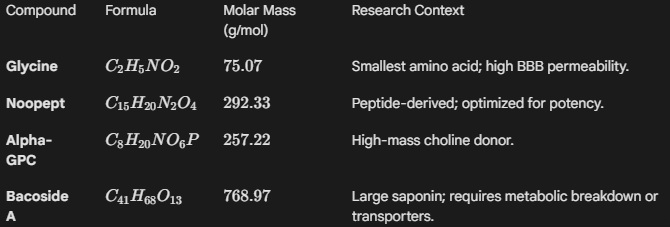
- The Blood-Brain Barrier (BBB) Threshold: In medicinal chemistry, the Rule of 5 (Lipinski's Rule) suggests that for a compound to be orally active and likely to cross cellular membranes, it should ideally have a molar mass under 500 g/mol. Most classic nootropics, such as Piracetam (142.16 g/mol) or Caffeine (194.19 g/mol), are well below this threshold. Larger molecules, such as certain peptides or complex glycosides, often require specialized delivery systems (like intranasal administration) due to their high molar mass.
- Molar vs. Mass Concentration: When conducting in vitro studies on neuronal cultures, researchers report concentrations in Micromolar (µM) or Nanomolar (nM) units. To convert a milligram dose into these units, the exact molar mass is required. This allows for the determination of Potency (how many molecules are needed to trigger a 50% response).
Comparative Molar Masses in Nootropics
Calculation in Research
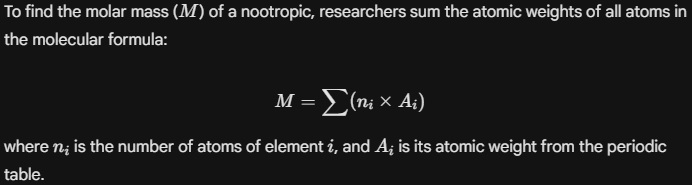
To find the molar mass (M) of a nootropic, researchers sum the atomic weights of all atoms in the molecular formula:
Primary Research Metrics
- Dalton (Da): In the context of large nootropic proteins or peptides (like Cerebrolysin), molar mass is often expressed in Daltons, where 1 Da = 1 g/mol.
- Stoichiometry: The use of molar mass to calculate the exact ratio of reactants needed to synthesize a nootropic compound in a laboratory setting.
Research Note: When evaluating "extracts," molar mass becomes complicated because the substance is a mixture. This is why researchers prefer Isolated Compounds; it allows for a "Molar Fix," ensuring that every milligram contains a predictable and countable number of bioactive molecules.
Myelin
Pronunciation: MY-uh-lin
Definition: Myelin is a specialized, multi-layered lipid-and-protein substance that forms an insulating sheath around the axons of neurons. In the Central Nervous System (CNS), it is synthesized by oligodendrocytes, while in the Peripheral Nervous System (PNS), it is produced by Schwann cells. Myelin is characterized by periodic interruptions known as Nodes of Ranvier, which facilitate saltatory conduction—the rapid "jumping" of action potentials from node to node. This structure significantly increases signal propagation speed (up to 100 times faster than unmyelinated fibers) and reduces the metabolic energy required for neural transmission.
The Nootropic Research Interface
In the study of cognitive enhancement, myelin is the primary focus for processing speed and long-range connectivity. Research into "pro-myelinating" agents is an emerging frontier in the treatment of age-related cognitive decline and "white matter" integrity.
- Oligodendrocyte Proliferation: Nootropics are evaluated for their ability to promote the differentiation of Oligodendrocyte Precursor Cells (OPCs) into mature, myelin-forming cells. Compounds like Clemastine or certain Cholinergic modulators are studied for this regenerative potential.
- White Matter Integrity: The brain's "White Matter" is composed almost entirely of myelinated axons. Nootropics that support the lipid architecture of myelin, such as DHA (Omega-3), Phosphatidylserine, and Uridine, are researched for their ability to maintain the structural "tightness" of the sheath.
- Neural Synchrony: Myelin thickness determines the exact timing of signal arrival. For complex executive functions (which require multiple brain regions to fire in perfect unison), myelin precision is critical. Nootropics that optimize myelination may improve "coherence" between the prefrontal cortex and the hippocampus.
- Metabolic Efficiency: Because myelin reduces the surface area of the axon that needs to be "reset" by the sodium-potassium pump after an action potential, it lowers the ATP cost of thinking. Myelin-supportive stacks are often paired with Mitochondrial boosters to maximize this bioenergetic advantage.
Composition and Biochemistry
- Lipid Fraction (~80%): Primarily composed of cholesterol, phospholipids, and galactocerebrosides. This high fat content provides the high electrical resistance necessary for insulation.
- Protein Fraction (~20%): Includes Myelin Basic Protein (MBP) and Proteolipid Protein (PLP), which act as the "molecular glue" that holds the spiral layers of the sheath together.
Primary Research Metrics
- DTI (Diffusion Tensor Imaging): An MRI-based technique used to measure Fractional Anisotropy (FA), a proxy for myelin integrity and white matter health in the living human brain.
- Conduction Velocity: Electrophysiological measurements of the speed at which a signal travels across a nerve fiber, used to quantify the functional benefits of a pro-myelinating nootropic.
- MBP Expression: A histological marker (Myelin Basic Protein) used in animal models to determine the literal thickness and coverage of the myelin sheath following treatment.
Research Note: While most nootropics target "Gray Matter" (synapses and receptors), "White Matter" (myelin) provides the structural infrastructure that makes those synapses useful. Without healthy myelin, the brain suffers from "Disconnectivity Syndrome," where individual nodes are functional, but the network is too slow to perform high-level integration.