
A - B - C - D - E - F - G - H - I - J - K - L - M - N - O - P - Q - R - S - T - U - V - W - X - Y - Z
L
Long-Term Memory
Pronunciation: LAWNG-term MEM-uh-ree
Definition: Long-term memory is the phase of information processing characterized by the stable, enduring storage of knowledge, skills, and experiences. Unlike short-term or "working" memory, which relies on transient electrical activity and fluctuating ion concentrations, LTM requires de novo protein synthesis and structural changes at the synapse, a process known as Consolidation. LTM is functionally divided into Declarative (Explicit) memory—facts and events mediated by the medial temporal lobe—and Non-Declarative (Implicit) memory—procedural skills and conditioning mediated by the cerebellum and basal ganglia.
The Nootropic Research Interface
In nootropic science, LTM is the primary benchmark for "cognitive permanence." Research focuses on the transition from labile, easily disrupted traces to fixed physical structures:
- The cAMP/PKA/CREB Pathway: This is the "master switch" for LTM. When a learning event is significant, it triggers a cascade that activates CREB (cAMP Response Element-Binding protein), which enters the nucleus to "turn on" genes for new synaptic growth. Nootropics like Forskolin or PDE4 inhibitors (e.g., Cistanche) are researched for their ability to keep this switch "on" for longer durations.
- Synaptic Tagging and Capture: LTM requires the brain to identify which specific synapses were active during a learning event and "tag" them to receive the proteins necessary for permanent strengthening.
- The Role of BDNF: Brain-Derived Neurotrophic Factor acts as the "fertilizer" for LTM, facilitating the growth of new dendritic spines. Nootropics that increase BDNF (e.g., Lion's Mane, Bacopa monnieri, or 7,8-DHF) are primarily studied for their impact on LTM retention rather than immediate focus.
Stages of the LTM Life Cycle
- Encoding: The initial transformation of sensory input into a neural trace.
- Consolidation: The hours-to-days process of stabilizing the trace via protein synthesis. This is where most nootropics exert their "permanent" effects.
- Storage: The long-term maintenance of the trace in the neocortex.
- Retrieval: The "calling up" of stored info. Nootropics that improve cholinergic tone (e.g., Alpha-GPC) often excel here.
- Reconsolidation: The process where a retrieved memory becomes "labile" again and can be updated or strengthened—a critical window for behavioral and cognitive interventions.
Primary Research Metrics
- Delayed Recall Tasks: Testing memory 24 hours to weeks after the initial learning phase to ensure LTM consolidation has occurred.
- Morris Water Maze: The gold standard animal model for testing LTM and spatial navigation, specifically targeting hippocampal function.
- Long-Term Potentiation (LTP): An electrophysiological measure of increased synaptic strength that lasts hours or days; the cellular proxy for LTM.
- Spine Density Imaging: Using two-photon microscopy to count the literal growth of new "heads" on dendrites following nootropic administration.
LTM vs. Working Memory
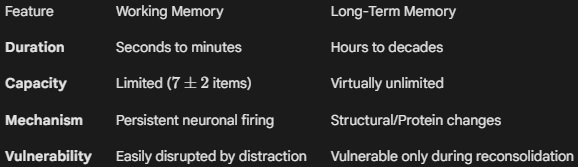
Research Note: Many users confuse "focus" with "memory." A stimulant might improve encoding (getting info in) without improving consolidation (keeping it there). True LTM-enhancing nootropics often require chronic dosing—sometimes weeks—to allow the physical "re-wiring" of the brain to manifest as improved recall.
Long-Term Potentiation
Pronunciation: LAWNG-term puh-ten-shee-AY-shun
Definition: Long-term potentiation is a persistent increase in synaptic strength following high-frequency stimulation of a chemical synapse. It is the primary cellular mechanism underlying synaptic plasticity and is widely considered the neurobiological foundation of learning and memory. LTP is characterized by an increase in the sensitivity of the post-synaptic neuron and an increase in the amount of neurotransmitter released by the pre-synaptic neuron, effectively "strengthening" the communication channel between two cells.
The Nootropic Research Interface
In nootropic research, LTP is the "gold standard" endpoint. A compound that facilitates or "lowers the threshold" for LTP is categorized as a true cognitive enhancer.
- Phase 1: Induction (E-LTP): The "early" phase, lasting 1–3 hours. It is primarily driven by the activation of NMDA receptors, which allow an influx of Calcium (Ca²+). Nootropics like Magnesium L-Threonate are researched for their ability to optimize the density of these receptors to facilitate induction.
- Phase 2: Expression: The post-synaptic membrane "upregulates" its AMPA receptors, making it more responsive to future glutamate release. AMPAkines (e.g., Aniracetam) work here by slowing the desensitization of these receptors.
- Phase 3: Stabilization (L-LTP): The "late" phase, which can last days or weeks. This requires protein synthesis and the activation of CREB. This is where "structural" nootropics like Bacopa monnieri or Lion's Mane exert their influence, ensuring that the potentiated state becomes permanent.
The "Hebbian" Principle
LTP is often summarized by the phrase "Cells that fire together, wire together." For a nootropic to be effective in this context, it must improve the associativity or specificity of this wiring, ensuring the brain doesn't just strengthen random noise, but rather relevant signals.
Key Molecular Requirements
- Depolarization: The post-synaptic cell must be sufficiently "excited" to expel the Magnesium plug from the NMDA receptor.
- Calcium Influx: Ca²+ acts as the secondary messenger that triggers the "strengthening" enzymes like CaMKII and PKC.
- Retrograde Signaling: The post-synaptic cell sends a signal (often Nitric Oxide) back to the pre-synaptic cell, telling it to release more glutamate in the future.
Primary Research Metrics
- fEPSP (Field Excitatory Post-Synaptic Potential): A measure of the electrical "punch" a synapse delivers. An increase in the slope of the fEPSP following stimulation is the definitive sign of successful LTP.
- Tetanic Stimulation: The high-frequency electrical "burst" used in lab settings to induce LTP and test a nootropic’s ability to protect or enhance the process.
- Dendritic Spine Morphogenesis: The physical growth of new synaptic "heads" following LTP, often visualized using fluorescent microscopy.
Research Note: While stimulants (like Caffeine) can increase general neuronal firing, they do not necessarily induce LTP. True "plasticity-enhancing" nootropics facilitate the efficiency of the transition from a single firing event to a long-term strengthened connection.