
A - B - C - D - E - F - G - H - I - J - K - L - M - N - O - P - Q - R - S - T - U - V - W - X - Y - Z
F
Fat Soluble (Lipophilic)
Pronunciation: fat SOL-yuh-bul
Definition: Fat solubility, or lipophilicity, refers to the physical property of a chemical compound to dissolve in fats, oils, lipids, and non-polar solvents (such as hexane or toluene) rather than in water. In a pharmacological context, this is quantified by the Partition Coefficient (Log P), which measures the ratio of a compound's concentration in a non-polar phase (octanol) versus a polar phase (water). Lipophilic molecules are typically non-polar and hydrophobic.
The Nootropic Research Interface
In neuropharmacology, a compound's fat solubility is perhaps the single most important factor determining its pharmacokinetic profile:
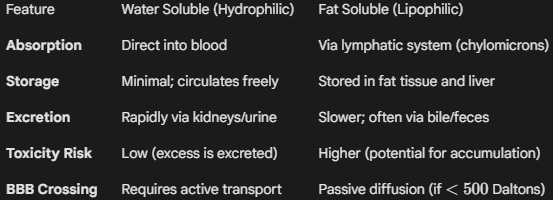
- Intestinal Absorption: Fat-soluble nootropics (e.g., Vitamin D, Omega-3 fatty acids, Aniracetam, Bacopa monnieri) often require the presence of dietary lipids to trigger the formation of micelles in the small intestine. Without a lipid co-ingestant, these compounds may exhibit poor bioavailability and high inter-subject variability in plasma levels.
- Crossing the Blood-Brain Barrier (BBB): The BBB is composed of endothelial cells with tight junctions and a lipid-rich basement membrane. Lipophilicity is a primary requirement for passive diffusion across this barrier. Nootropic research often involves modifying the structure of a water-soluble molecule to make it more lipophilic (e.g., converting Thiamine into the fat-soluble Sulbutiamine) to ensure it reaches the Central Nervous System.
- Adipose Sequestration and Half-Life: Unlike water-soluble compounds that are rapidly excreted via the kidneys, fat-soluble substances can be stored in adipose (fat) tissue and the liver. This can lead to a longer biological half-life (t1/2) and a "cumulative effect," where the substance remains in the system for days or weeks after the final dose.
Comparative Pharmacokinetics
Primary Research Metrics
- Log P: The octanol-water partition coefficient. A Log P value between 1 and 3 is generally considered ideal for a nootropic to achieve both intestinal absorption and BBB penetration.
- PSA (Polar Surface Area): A metric used to predict drug transport. Generally, a PSA < 60–70 A2 is required for a lipophilic molecule to cross the BBB effectively.
- Micellar Solubilization Rate: A measurement used in in vitro digestion models to determine how well a fat-soluble nootropic is packaged for absorption.
Research Note: When designing protocols for fat-soluble nootropics, researchers must standardize the lipid content of the subjects' meals. A "fasted" vs. "fed" state can result in a 2x to 10x difference in the Cmax (peak concentration) of lipophilic compounds, which can fundamentally skew data regarding efficacy.
Focus
Pronunciation: FOH-kus
Definition: Focus is the operational manifestation of Selective Attention—the cognitive ability to isolate and process a specific subset of sensory or internal information while concurrently suppressing irrelevant stimuli. Unlike "concentration" (which often refers to the depth of attention over time), focus describes the precision and exclusivity of the attentional spotlight. It is an emergent property of the Prefrontal Cortex (PFC), specifically involving the gating of information flow between the thalamus and the cortex.
Neurobiological Mechanism
In a research context, focus is defined by the Signal-to-Noise Ratio (SNR) in neuronal firing.
- Signal Enhancement: Mediated by Norepinephrine acting on alpha2A receptors, which strengthens the "signal" of task-relevant neurons.
- Noise Suppression: Mediated by Dopamine acting on D1 receptors, which reduces the "background noise" or spontaneous firing of task-irrelevant neurons.
The Nootropic Research Interface
Research into focus-enhancing nootropics focuses on the optimization of these catecholaminergic pathways to prevent "attentional drift."
- Sustained Attention: The ability to maintain focus during long, monotonous tasks. Research metrics often include the Psychomotor Vigilance Task (PVT).
- Divided Attention (Multi-tasking): The rapid switching of the focal point. While often sought after, research suggests that most nootropics actually improve linear focus by reducing the "cost" of task-switching rather than enabling simultaneous processing.
- Hyper-Focus: A state of intense, narrow attention (often associated with high-dose stimulants) where the subject may lose the "top-down" ability to shift focus when necessary, leading to cognitive inflexibility.
Primary Research Metrics
- Stroop Interference Task: Measures the ability to maintain focus on a specific attribute (color) while ignoring a conflicting attribute (the word).
- Flanker Task: Assesses the capacity to focus on a central target while ignoring "flanking" distractors.
- d' (d-prime): A statistical measure used in signal detection theory to quantify a subject's sensitivity to a signal versus noise; a direct proxy for the "quality" of focus.
- Steady-State Visually Evoked Potentials (SSVEP): EEG measurements used to track how the brain "locks on" to a specific visual stimulus.
Focus vs. Arousal
Researchers must carefully distinguish between these two states:
- Arousal is a state of general physiological wakefulness (driven by the Reticular Activating System).
- Focus is the direction of that wakefulness (driven by the Prefrontal Cortex).
Research Note: A compound can be highly "arousing" (e.g., high-dose Caffeine) without being "focus-enhancing." If the arousal is too high, it can actually degrade focus by increasing "noise" and jitter in the neural circuits.
Free Radicals
Pronunciation: free RAD-ih-kulz
Definition: A free radical is an atom, molecule, or ion that possesses one or more unpaired electrons in its outer shell. This electronic configuration renders the species highly unstable and chemically "aggressive." To achieve stability, free radicals engage in rapid, non-specific reactions to "steal" or donate electrons from neighboring molecules—a process known as oxidation. In neurobiology, the most significant free radicals are Reactive Oxygen Species (ROS) and Reactive Nitrogen Species (RNS).
The Nootropic Research Interface
The brain is disproportionately vulnerable to free radical damage due to its high oxygen consumption (utilizing ~20% of the body’s O2), high concentration of easily-oxidized polyunsaturated fatty acids (PUFAs), and relatively low levels of endogenous antioxidant enzymes compared to other tissues.
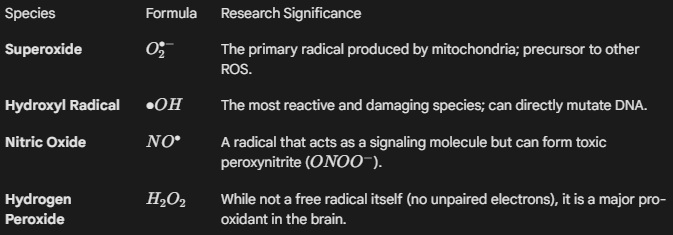
- Mitochondrial "Leaking": Free radicals are primarily generated as byproducts of the Electron Transport Chain (ETC). In a high-performance cognitive state, increased ATP production can lead to an increased "leakage" of superoxide radicals (O2-), making mitochondrial health a primary focus of neuroprotective nootropics.
- Lipid Peroxidation: Free radicals frequently attack the lipid-rich myelin sheath and neuronal membranes. This triggers a chain reaction that compromises membrane fluidity and receptor anchoring, effectively degrading the "hardware" required for signal transduction.
- The "Antioxidant" Countermeasure: Nootropics such as Astaxanthin, PQQ, and Resveratrol are researched for their ability to function as "electron donors," neutralizing free radicals before they can initiate cascading damage to the DNA or proteome.
Key Radical Species in the CNS
Mechanisms of Damage
- Protein Carbonylation: Free radicals can alter the shape and function of essential enzymes and structural proteins, leading to protein "misfolding."
- DNA "Nicking": Oxidation of the DNA backbone (specifically the formation of 8-OHdG) can lead to strand breaks and genomic instability, particularly in the post-mitotic environment of the neuron.
- Excitotoxicity Path: Excessive free radical accumulation can trigger the release of Glutamate, potentially leading to a self-perpetuating cycle of neuronal over-excitation and death.
Primary Research Metrics
- MDA (Malondialdehyde) & TBARS: Common biomarkers used to quantify the level of lipid peroxidation in brain tissue or plasma.
- ORAC (Oxygen Radical Absorbance Capacity): A laboratory assay used to measure the antioxidant power of a nootropic compound.
- GSH/GSSG Ratio: The ratio of reduced to oxidized glutathione; a primary indicator of the "Redox Status" of the CNS.
Research Note: While free radicals are often portrayed as purely destructive, they also function as essential signaling molecules at low concentrations (hormesis). Excessive "quenching" of free radicals via massive antioxidant dosing can sometimes interfere with the brain's natural adaptive responses to exercise and learning.